Opening
Jannis
Jannis opened the day and set the frame for what followed.
Lessons from the front lines of AI adoption
Liam Ottley
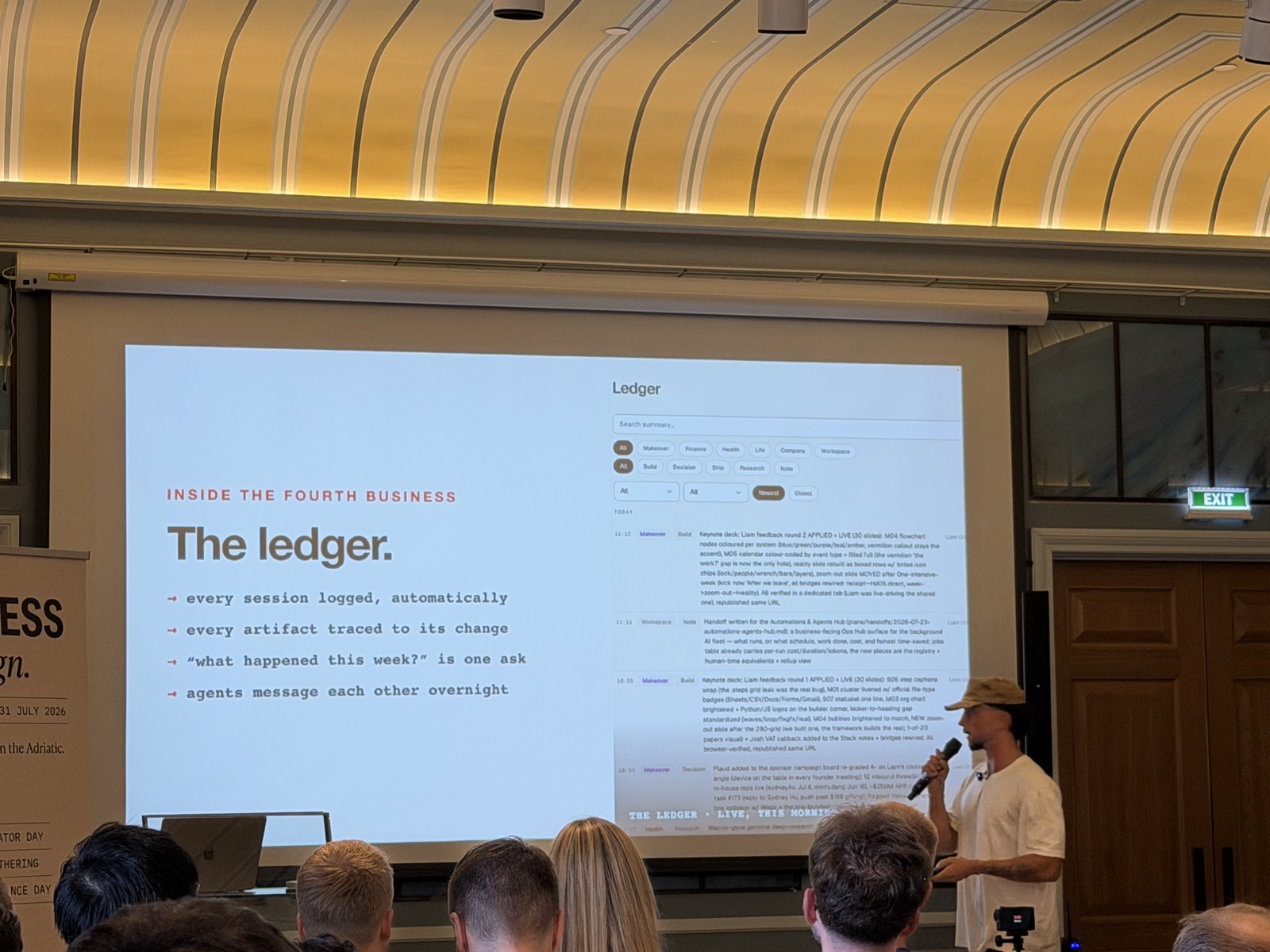
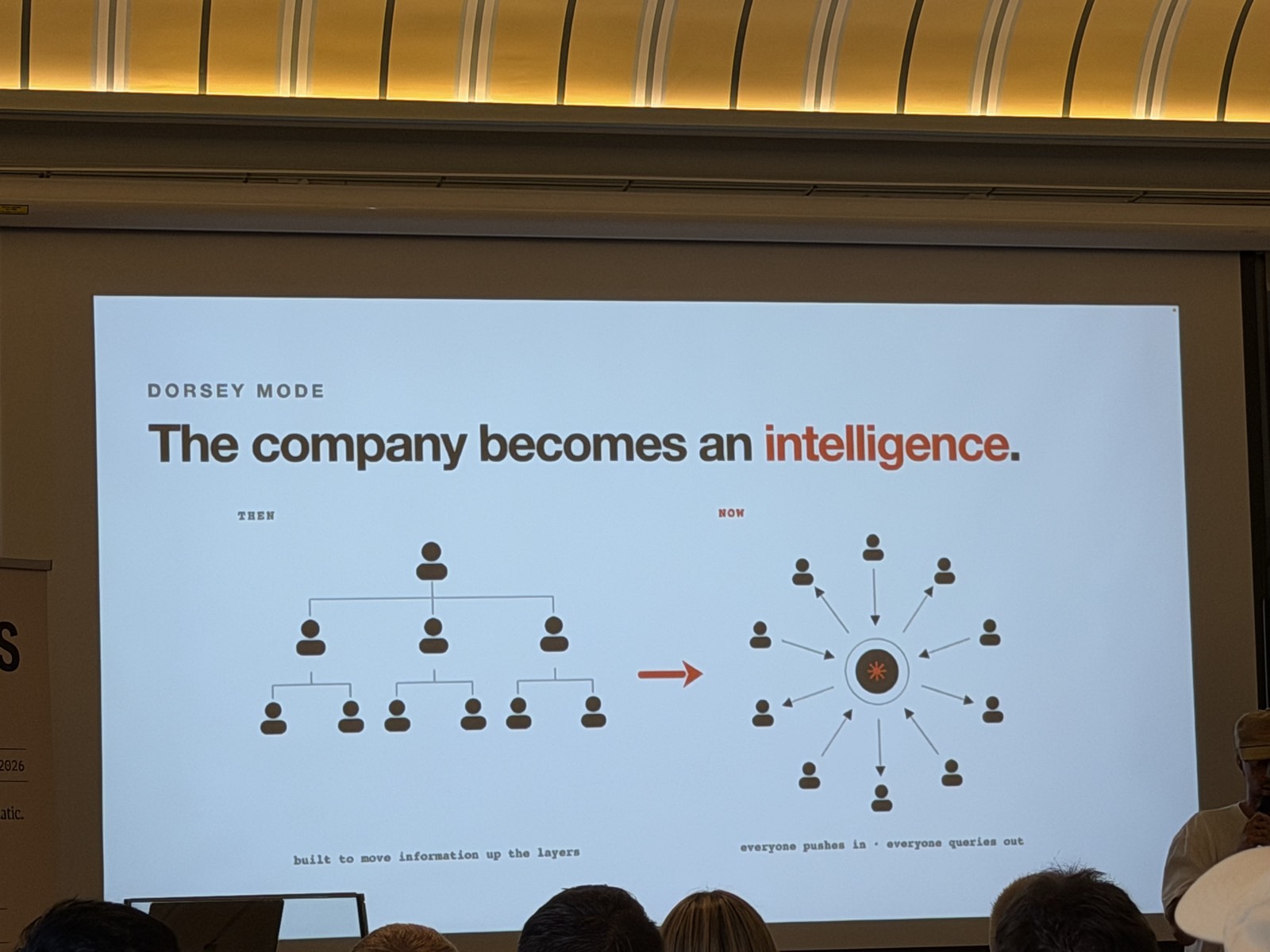
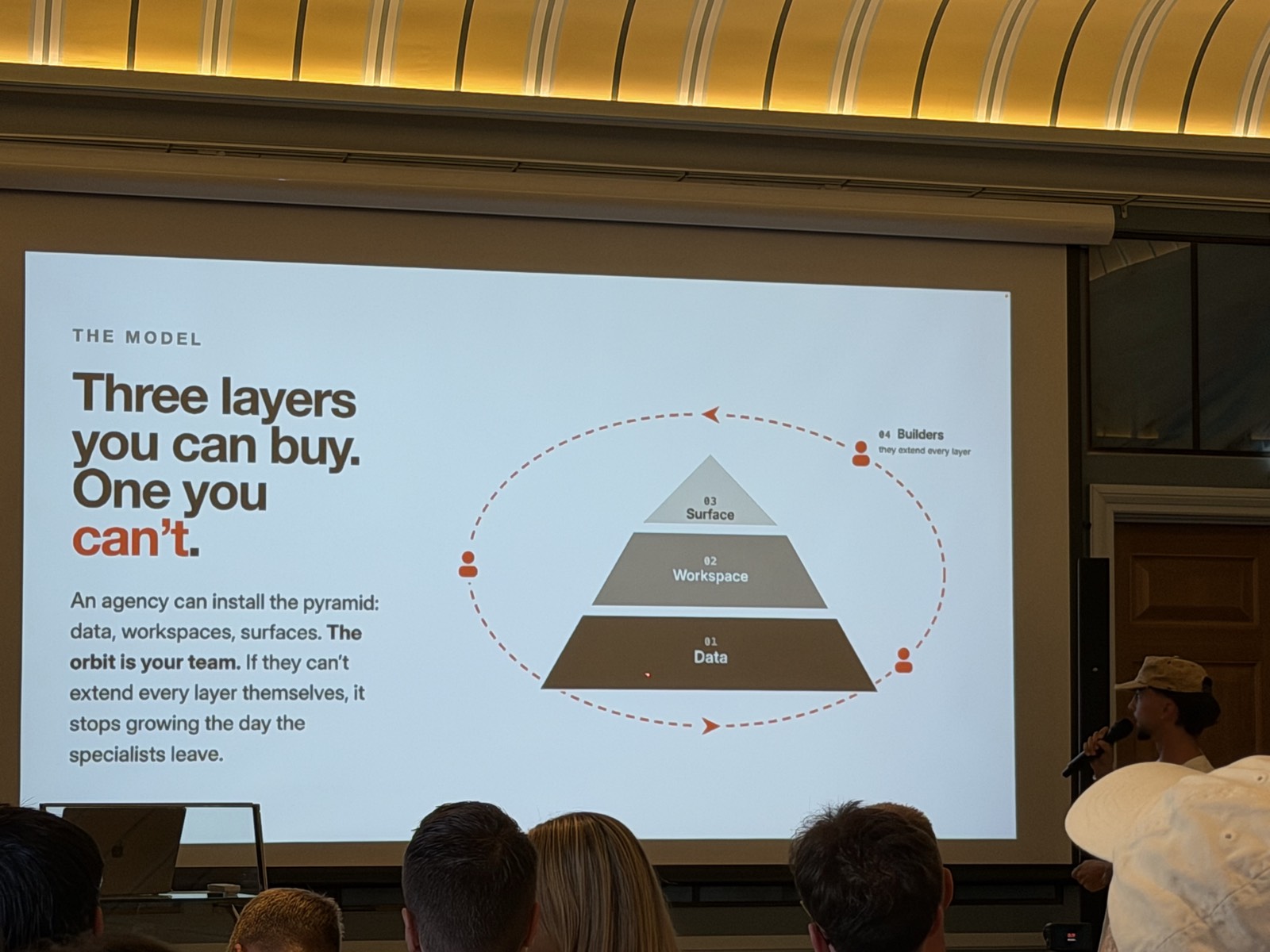
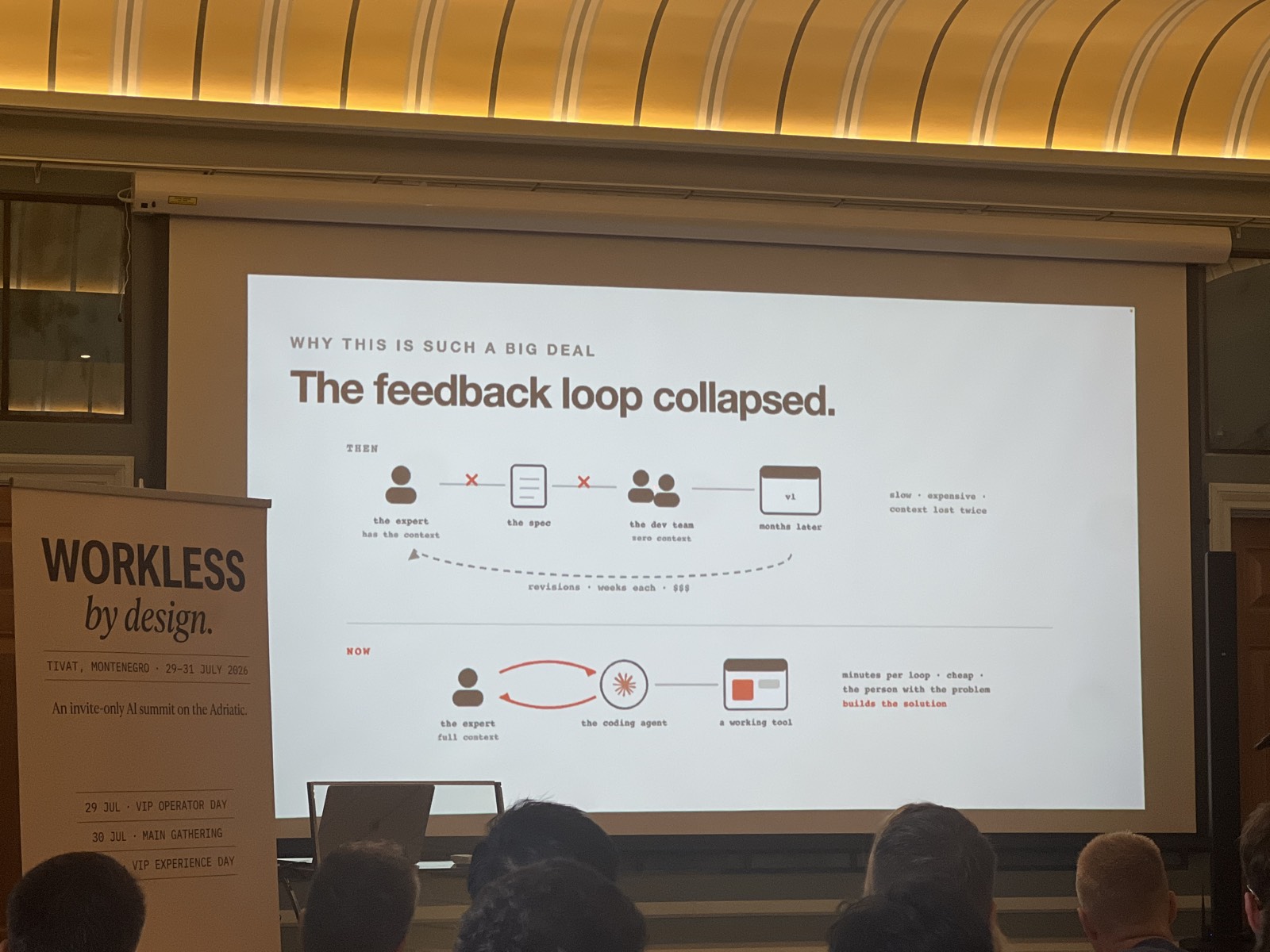
The Morningside AI founder walked through five common AI-adoption mistakes drawn from recent client work, and his fix: an "AI workspace" where non-technical staff build their own tools with a coding agent. Attendees were handed a starter workspace zip to try themselves.
Key ideas
- Five mistakes: scattered data AI cannot reach; no centralised AI strategy; treating AI as a developer-only job; rigid automations on unstable processes; work invisible outside meetings.
- Skills vs automation rule: flexible skills for unstable processes; rigid automation only where nothing will change within about six months. Worked example: an accounting firm's working-papers process cut from about an hour to about 15 minutes (their figure).
- The "Ledger": every piece of work, human or agent, continuously logged so managers see progress without meetings.
- Delivery model: the "AI Makeover", an intensive week of setup ("seven months of progress in seven days"), after which the client's team self-manages.
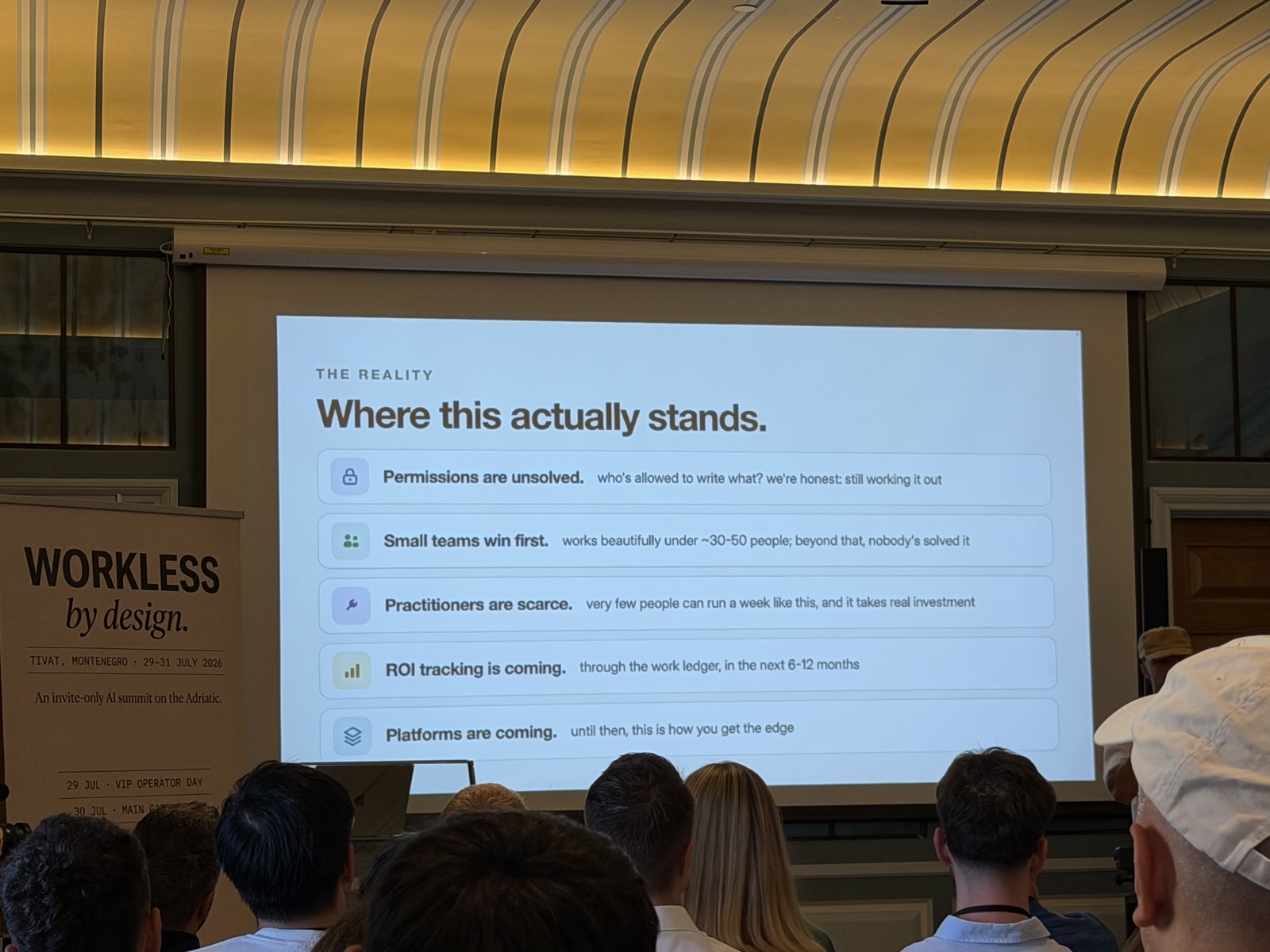
- Small teams are winning right now: enterprises are slowed by security and permissions; open, flexible systems favour smaller companies.
Slides (5)
Mastering agentic workflows
Mark Kashef
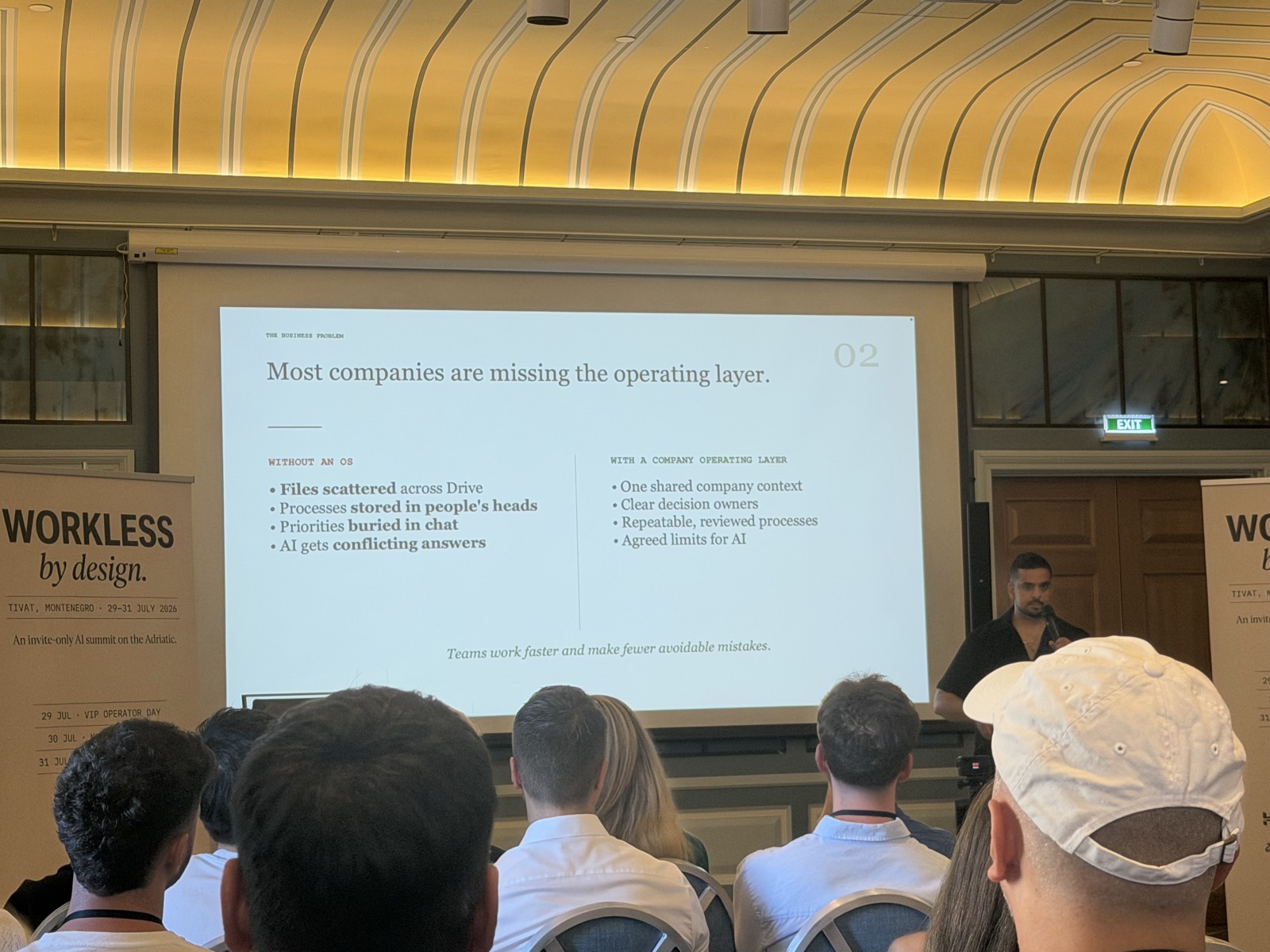
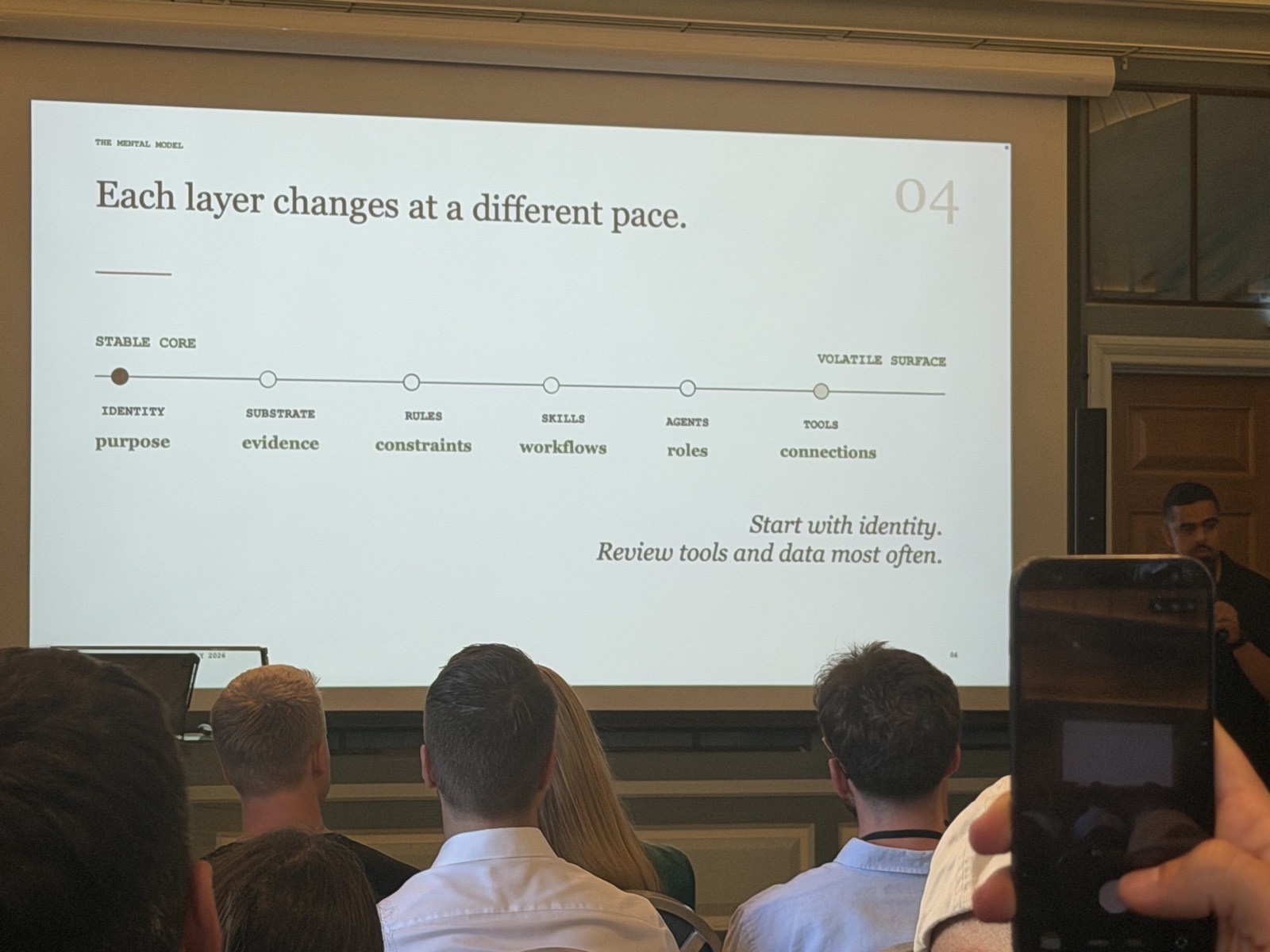
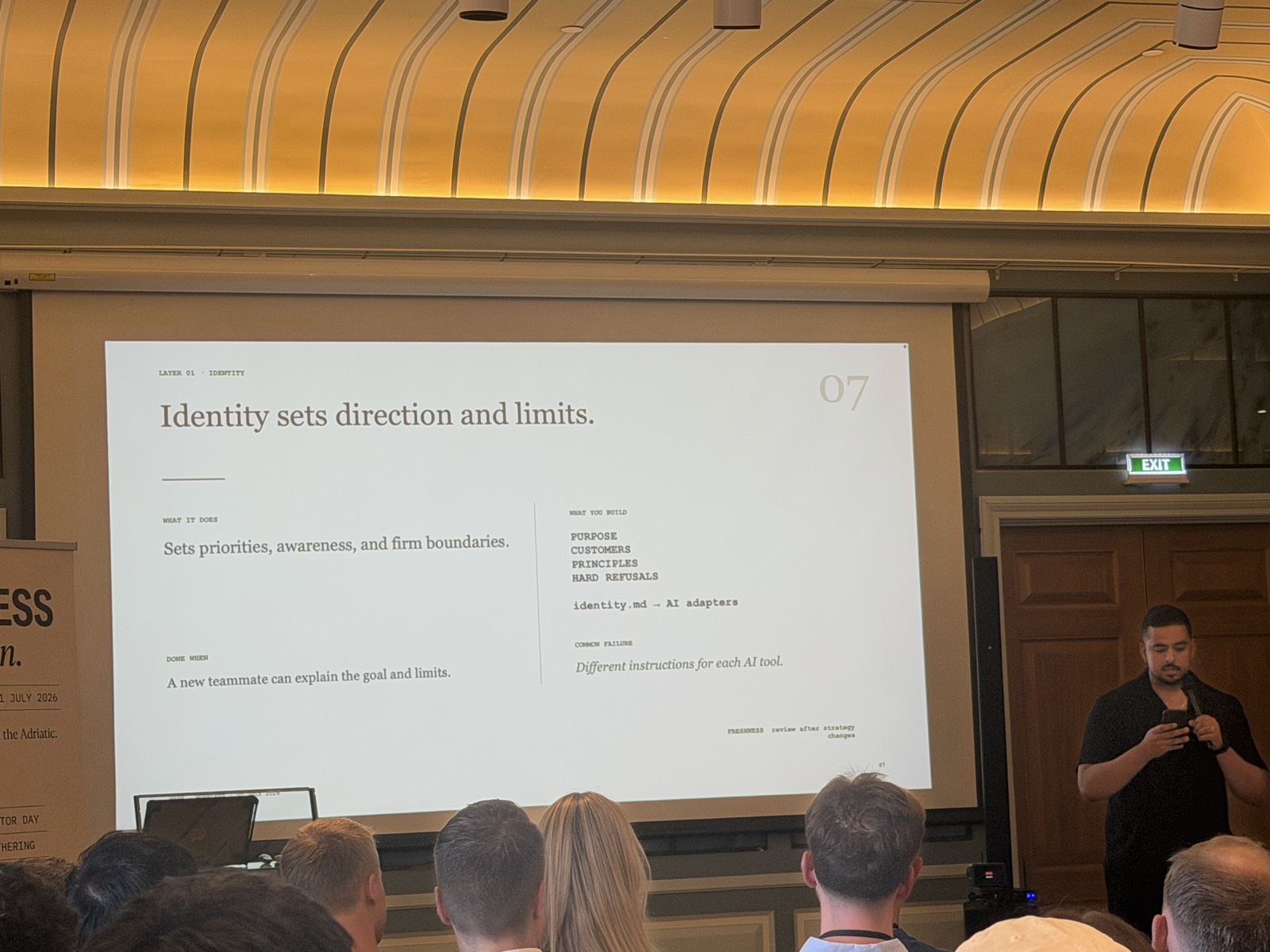
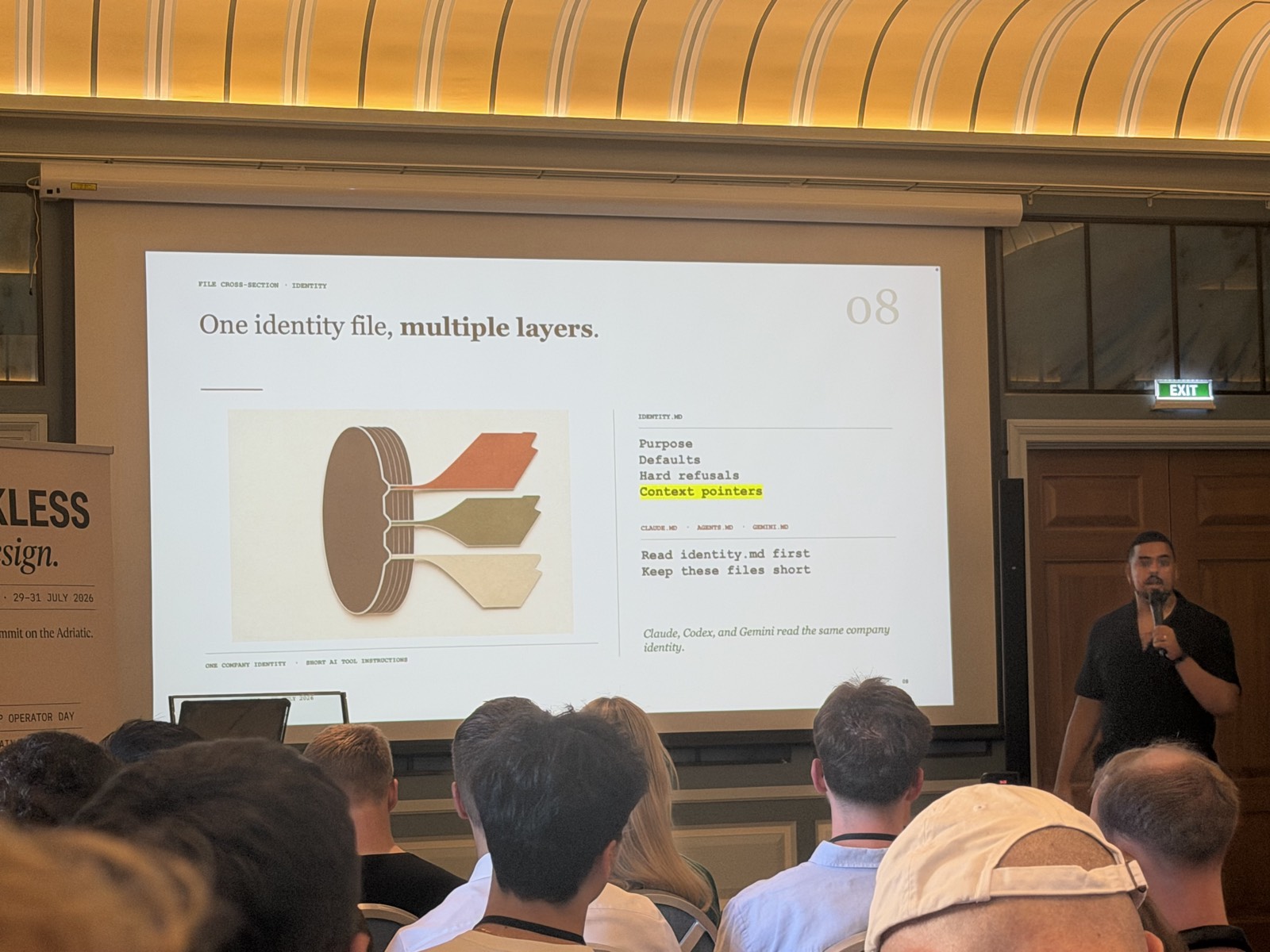
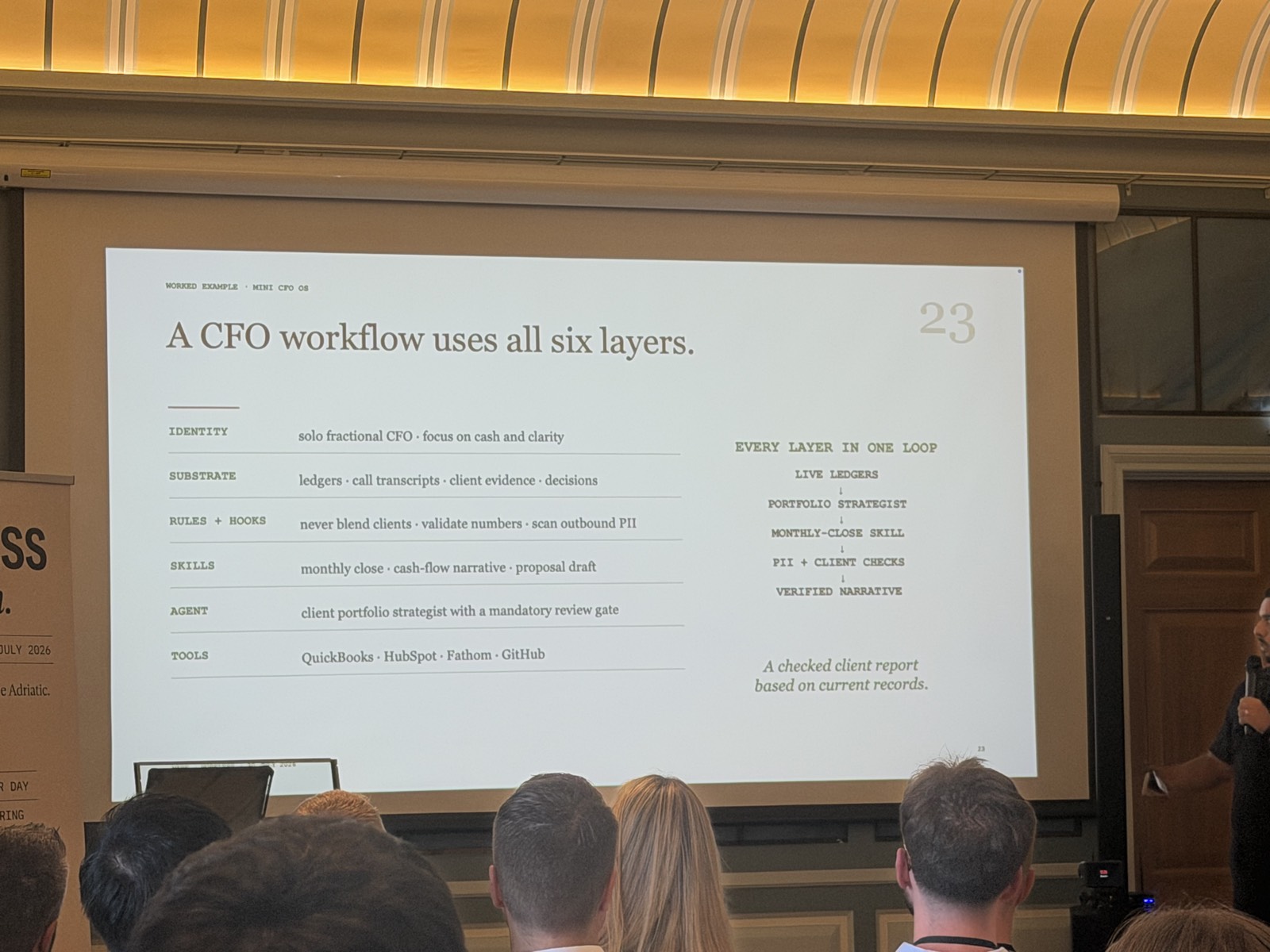
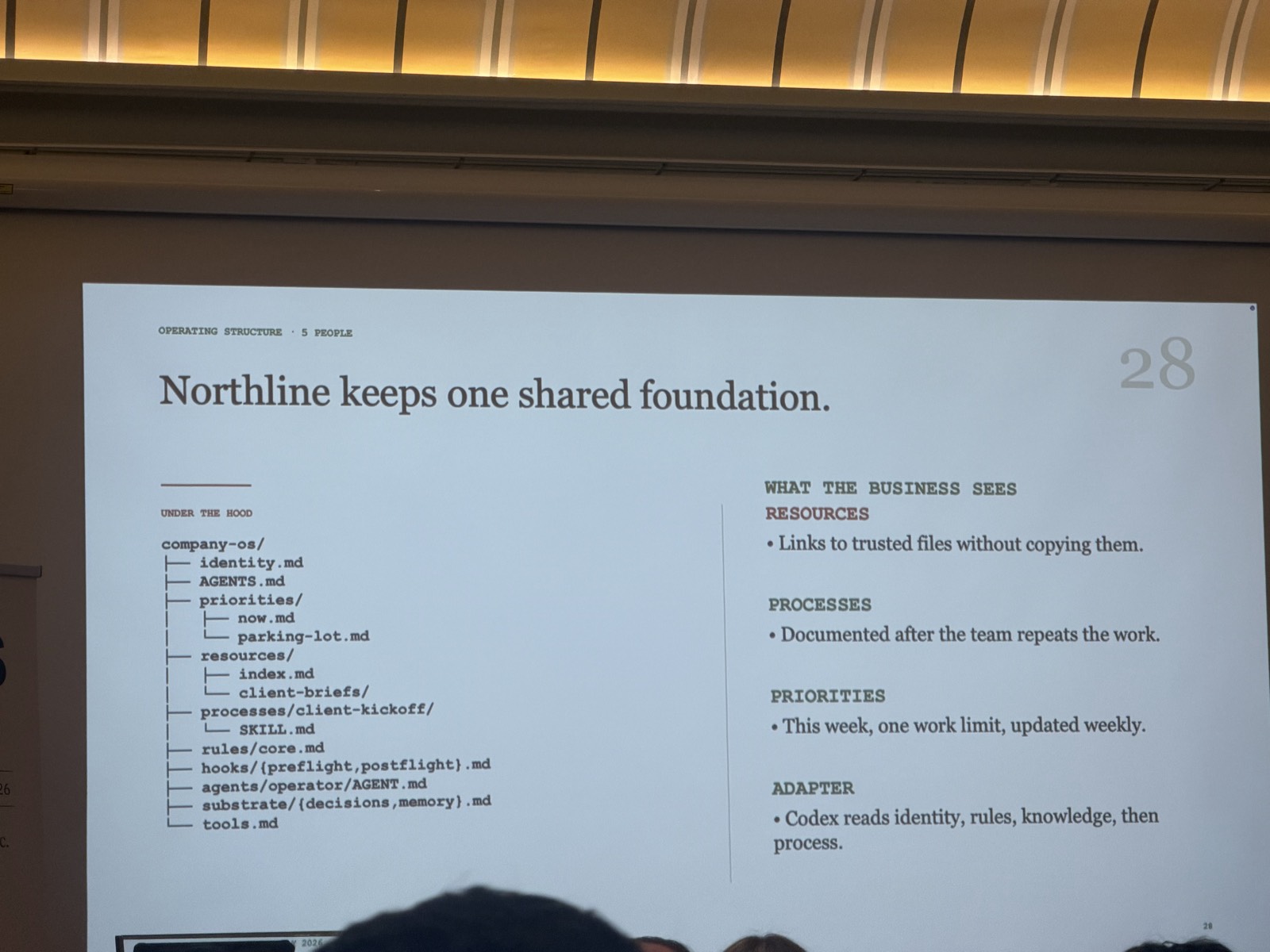
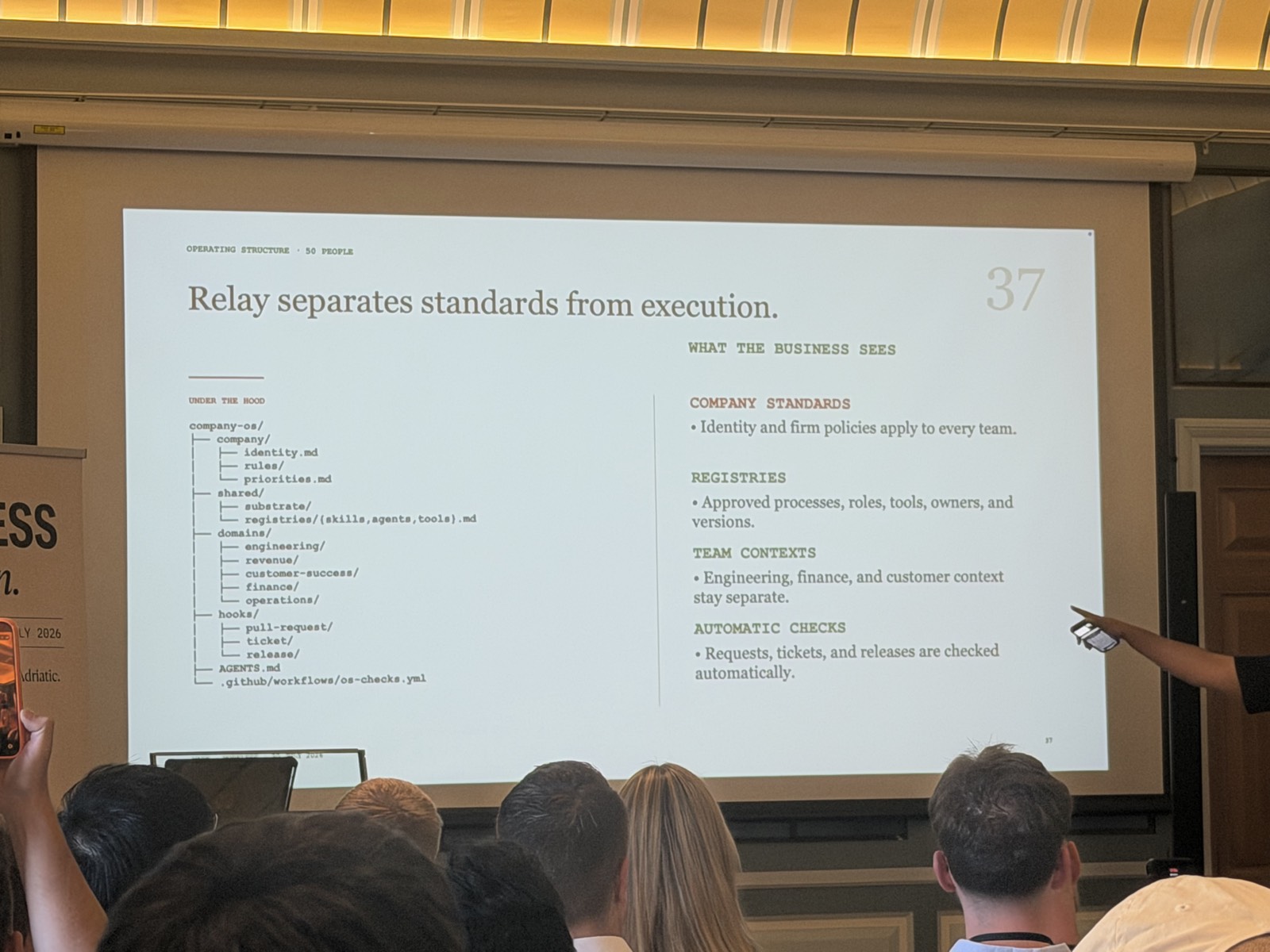
A layered AI-operating-system architecture and how it scales from 5 to 1,000 people: identity at the centre, then substrate, rules, hooks (the only deterministic layer), skills and connections. The commercial heart of the talk was "rot": a system starts becoming obsolete the minute it is built, and someone has to be its plumber.
Key ideas
- Layer model: identity (changes about yearly, includes a librarian index of file paths), substrate (durable files), rules (change often), hooks (when X then Y, 100% of the time), skills and workflows, connections.
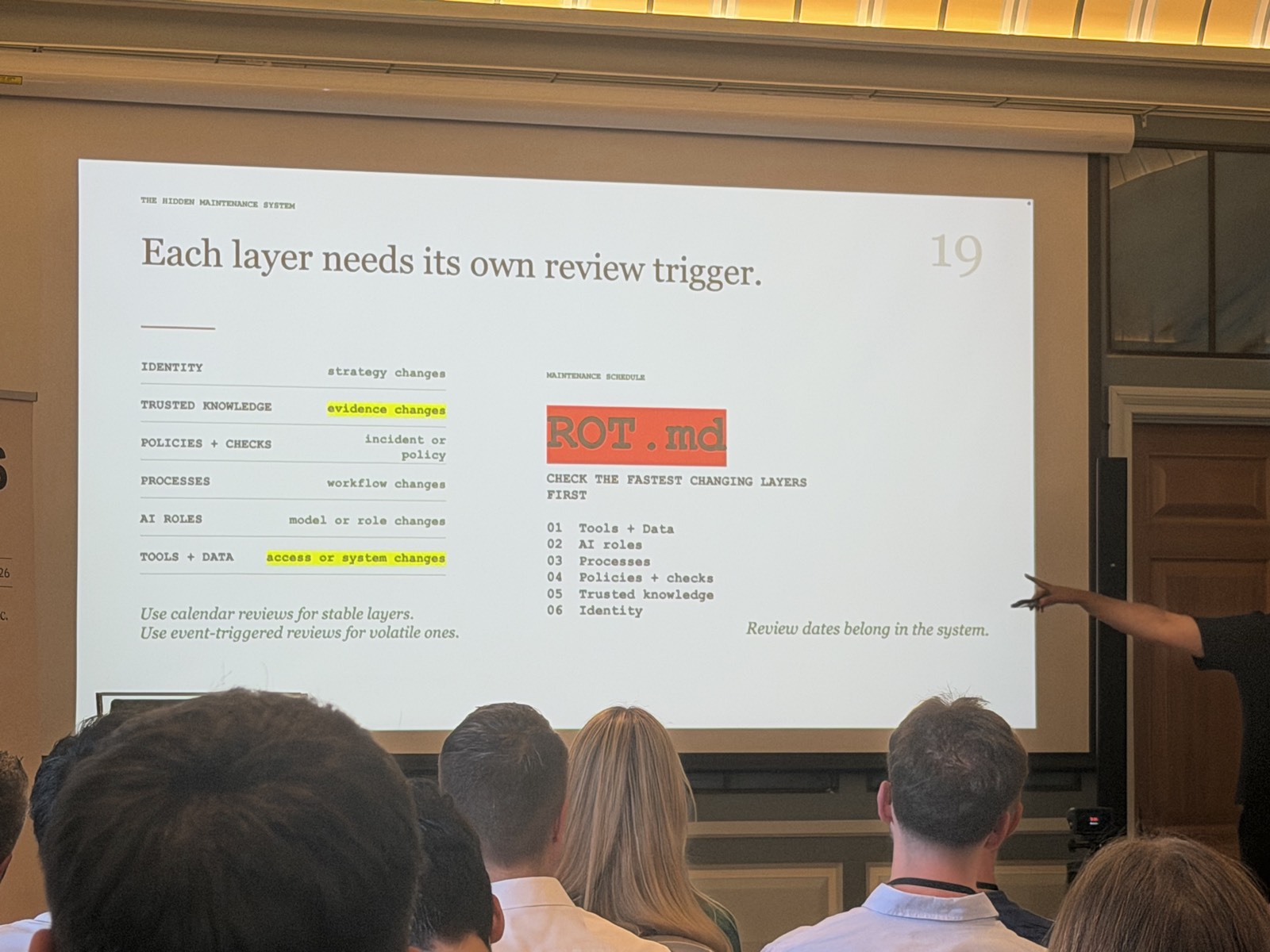
- "Rot": he keeps a maintenance file cataloguing every file and process with its expected obsolescence window per layer. "Plumbing is the most profitable thing in AI."
- Hooks as compliance: he spent a month hardening hooks for one client so wrong-client data could never route to a wrong-client surface.
- Rollout by company size: 5 people = a NOW vs BACKLOG list; 15 = AI stewards per team, department by department starting revenue-adjacent; 50+ = departmental playbooks and information gating; 1,000 = hardened hooks and strict governance.
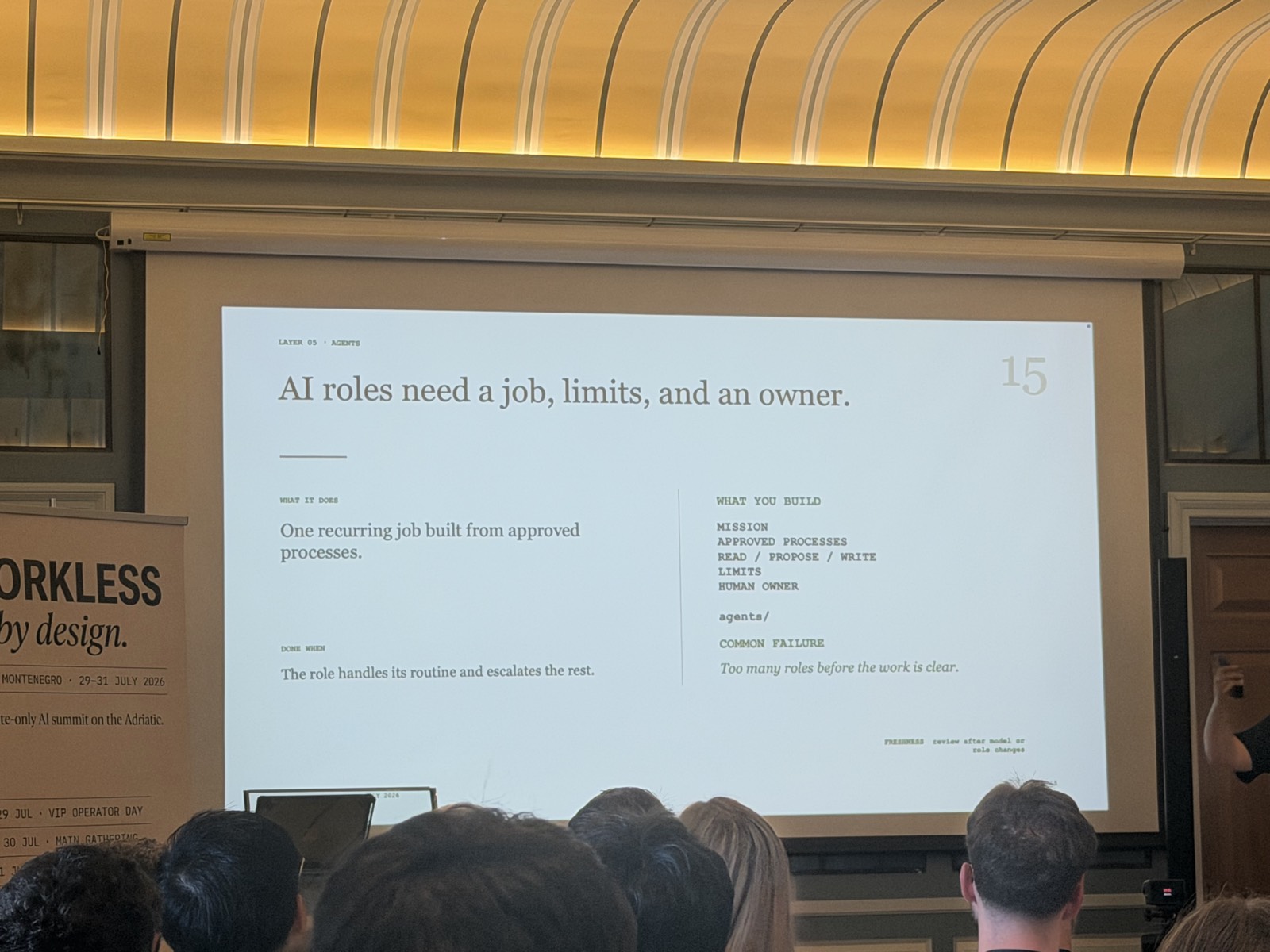
- Agent-hiring philosophy: an agent is a job; start with one, split only when scope gets weird, because errors cascade.
- Six-month purge: delete old skills and instruction detail every six months or so; old scaffolding handicaps newer models.
Slides (9)
ClickUp takes the stage
Chris Cunningham (co-founder, ClickUp)
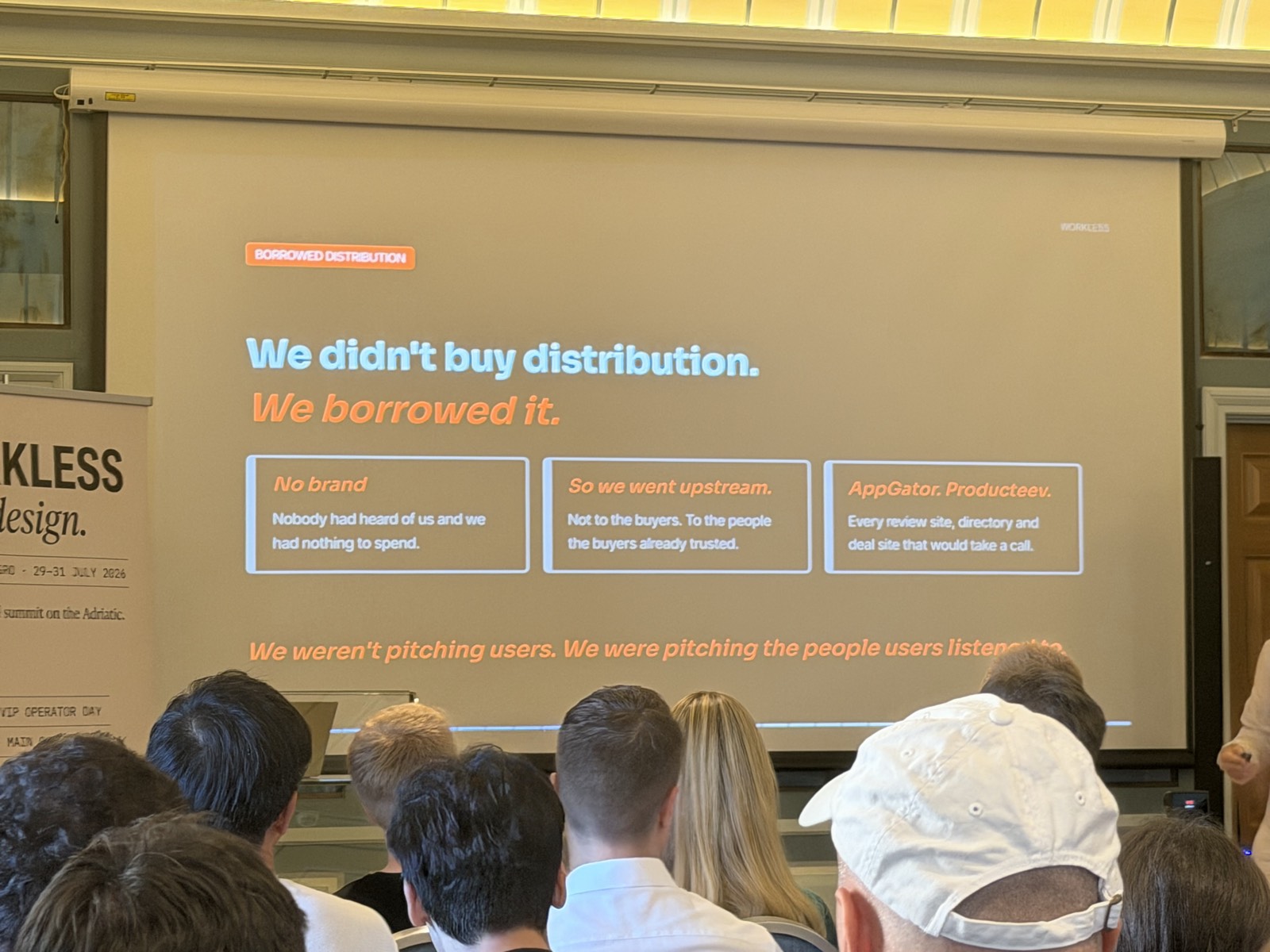
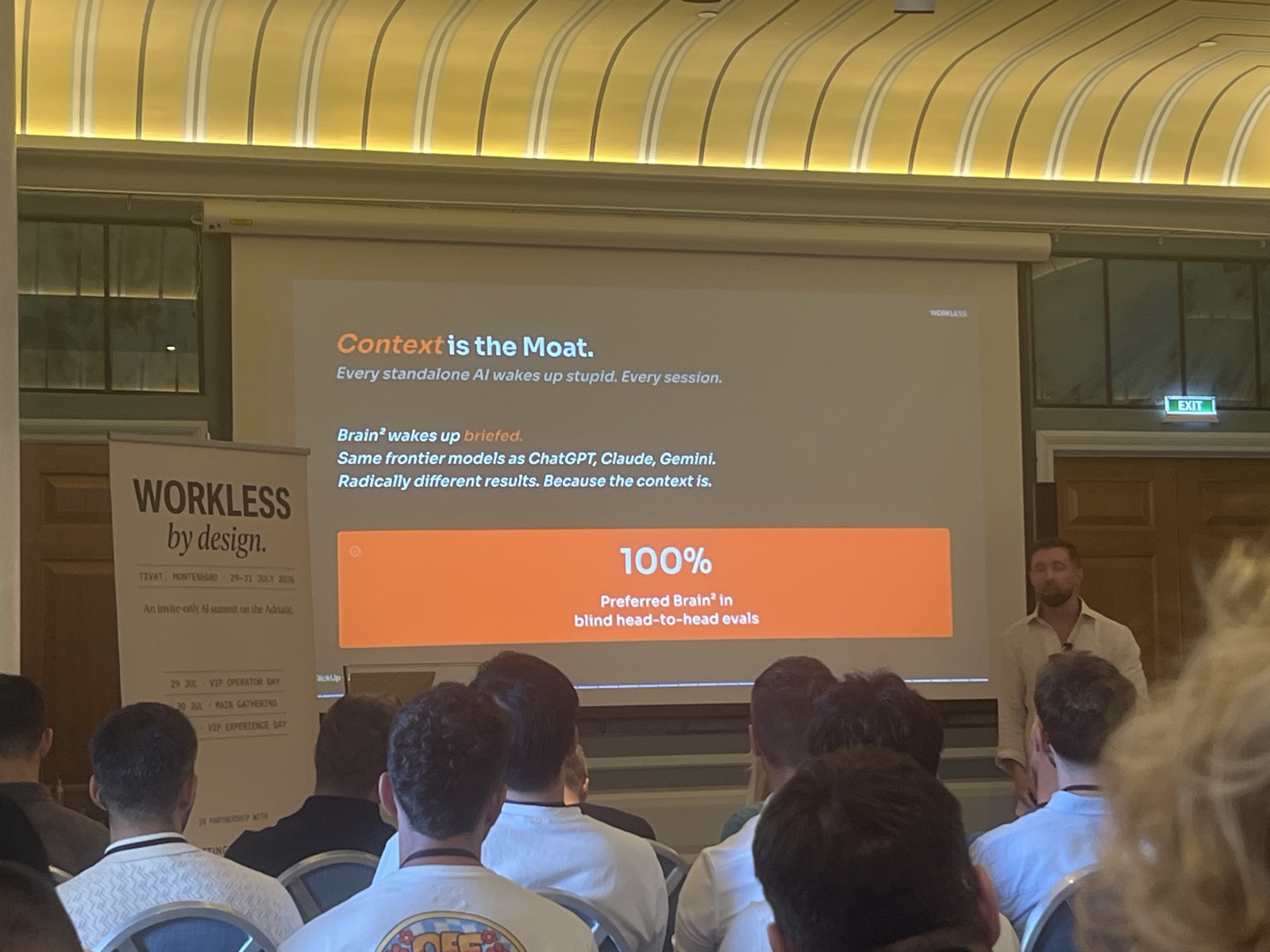
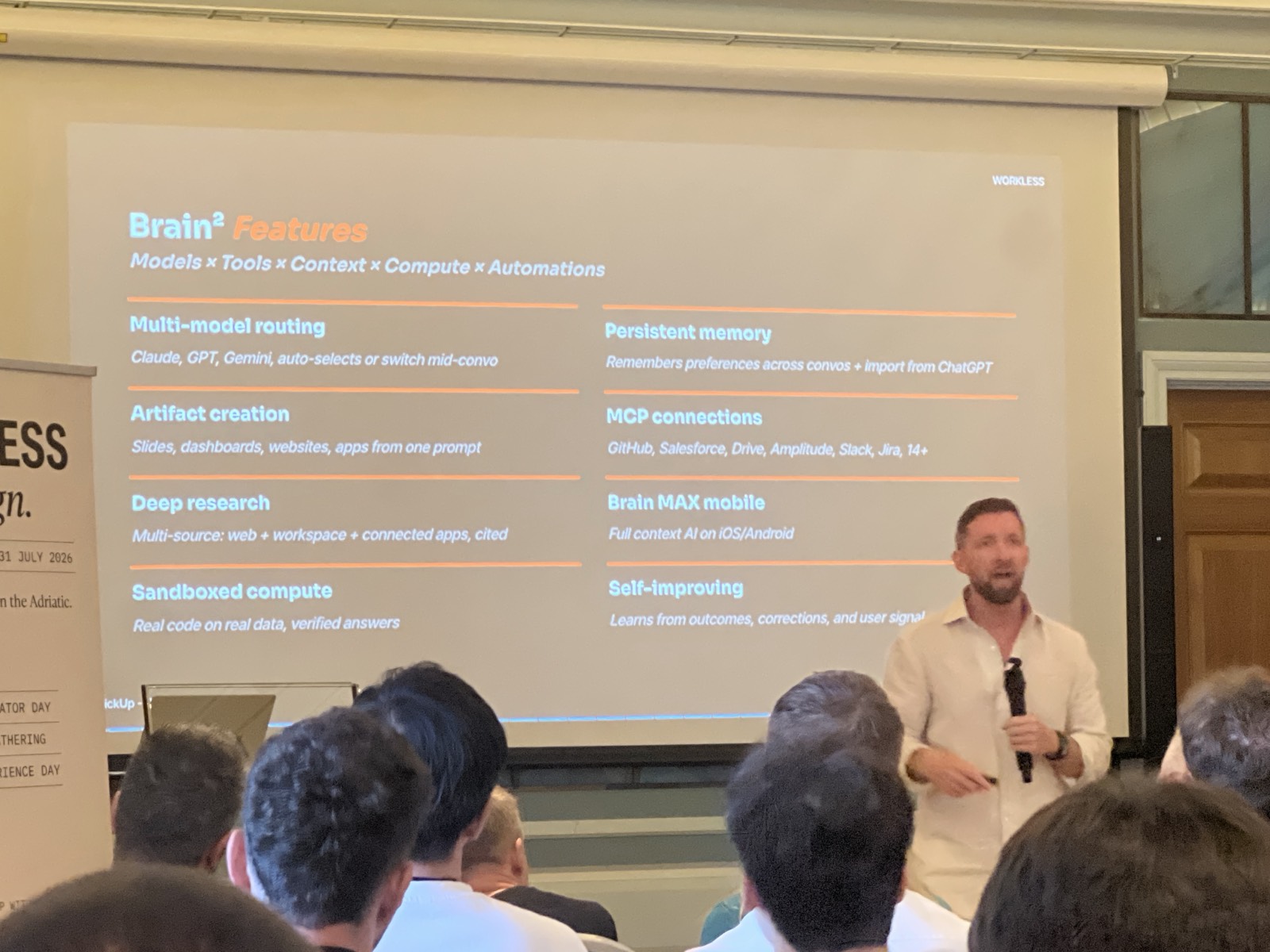
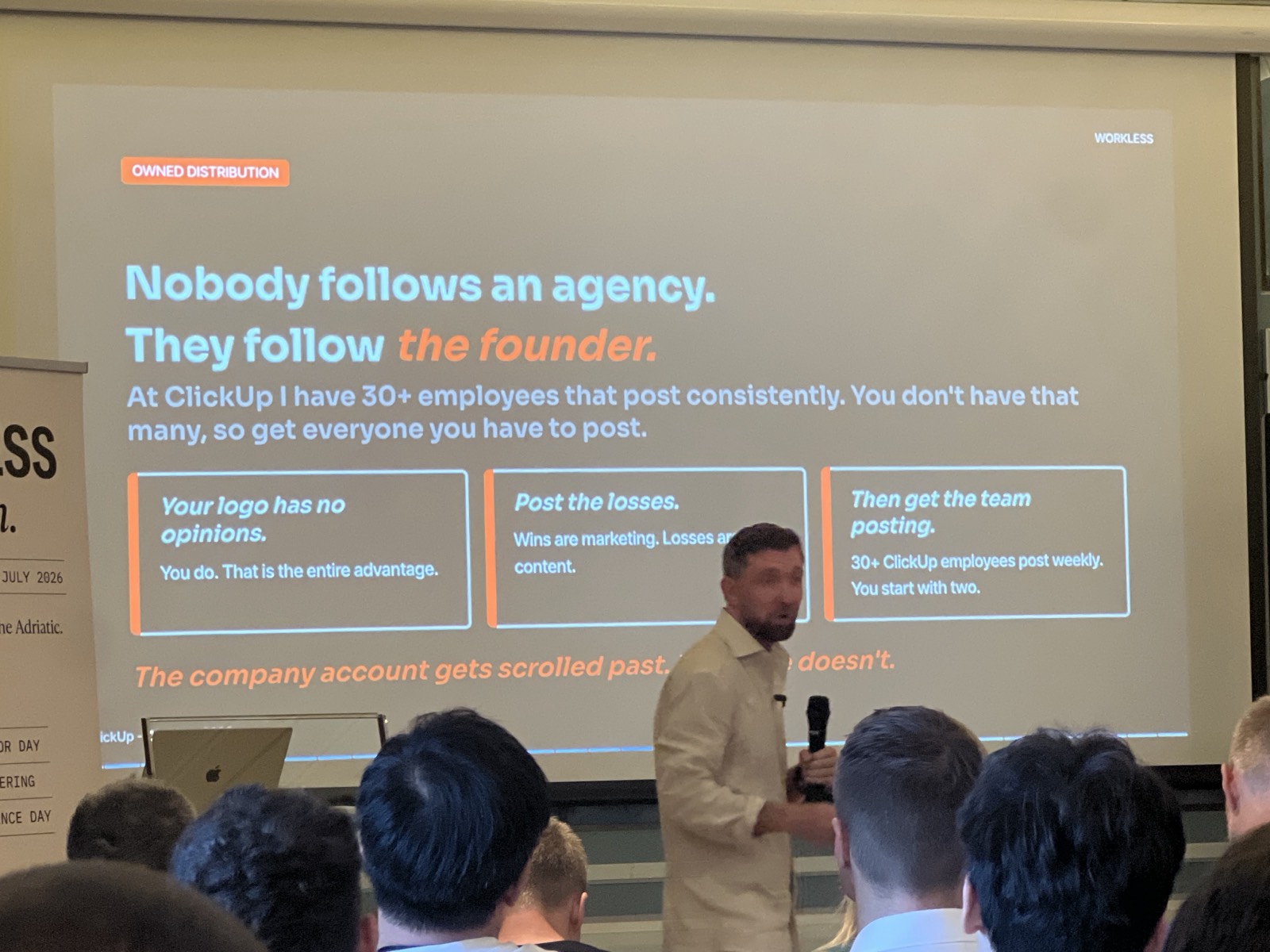
The ClickUp co-founder's growth playbook: audience beats product, scrappy acquisition, and the strategic bet that context is the moat. The talk ranged from the "Jira Sucks" ad to answer-engine optimisation and employee-generated content.
Key ideas
- Audience beats product: their pre-ClickUp app was better than Snapchat's clone and still died. "No matter how good your product, it means nothing if no one sees it."
- Scrappy plays: scraped competitors' 2-star reviews and contacted the unhappy customers; when a competitor shut down, they built a migration tool in three days and onboarded around 20,000 users (his figure).
- "Swing up": attack bigger competitors by name; incumbents will not punch down.
- AEO replaces SEO: get cited by the answer engines people actually ask, by showing up on the platforms those engines read, often via many small creators rather than a few big ones.
- Employee-generated content: 30+ employees posting daily; people follow people, not logos; raw phone-shot beats polished.
- Rule of three: every post must solve something, make them laugh, or make them feel something. Otherwise do not post.
- "Context is our focus": models are interchangeable; the company that owns the context of work wins.
Slides (4)
AI workshops to company brain
Riccardo Belli Contarini
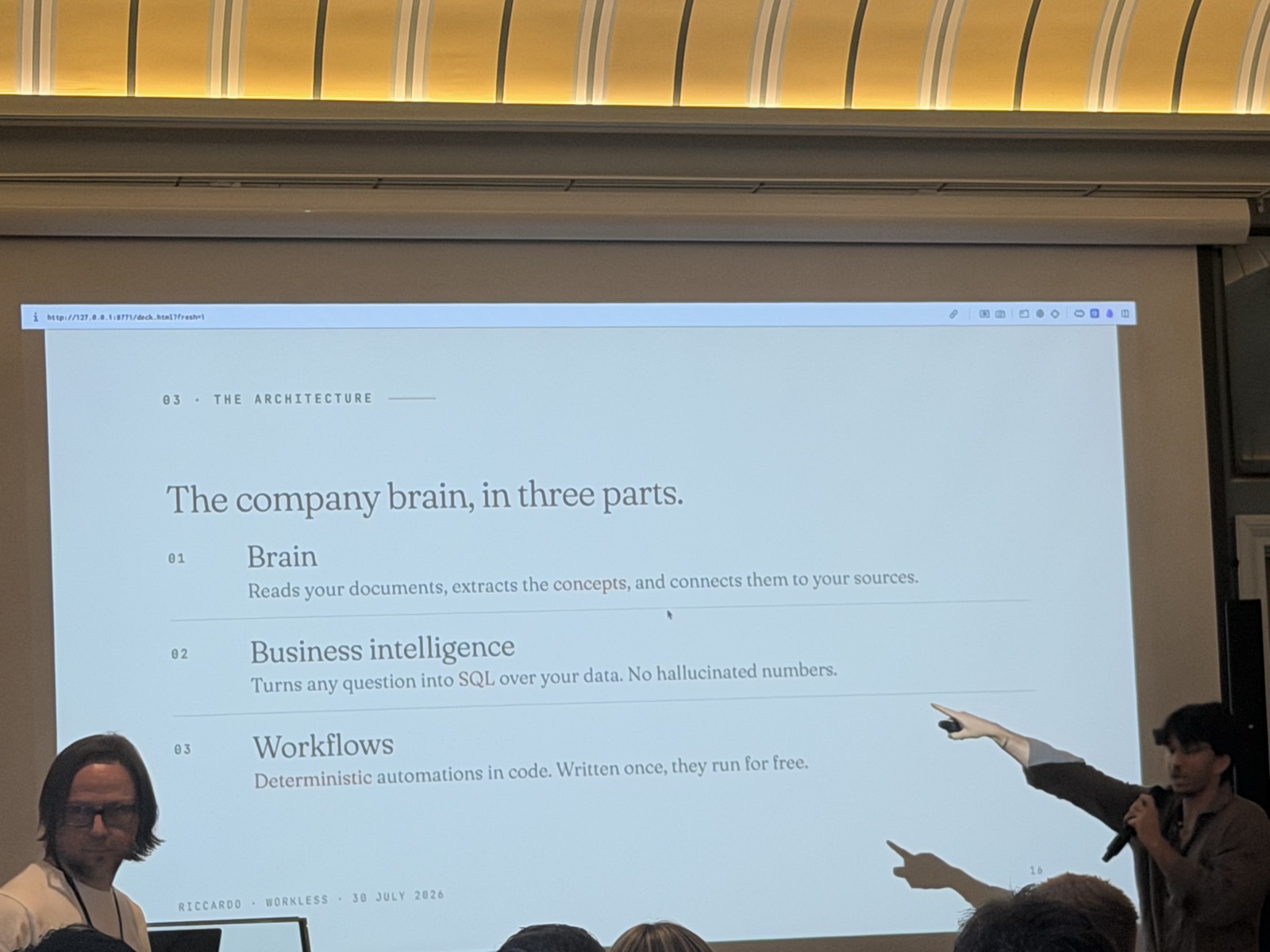
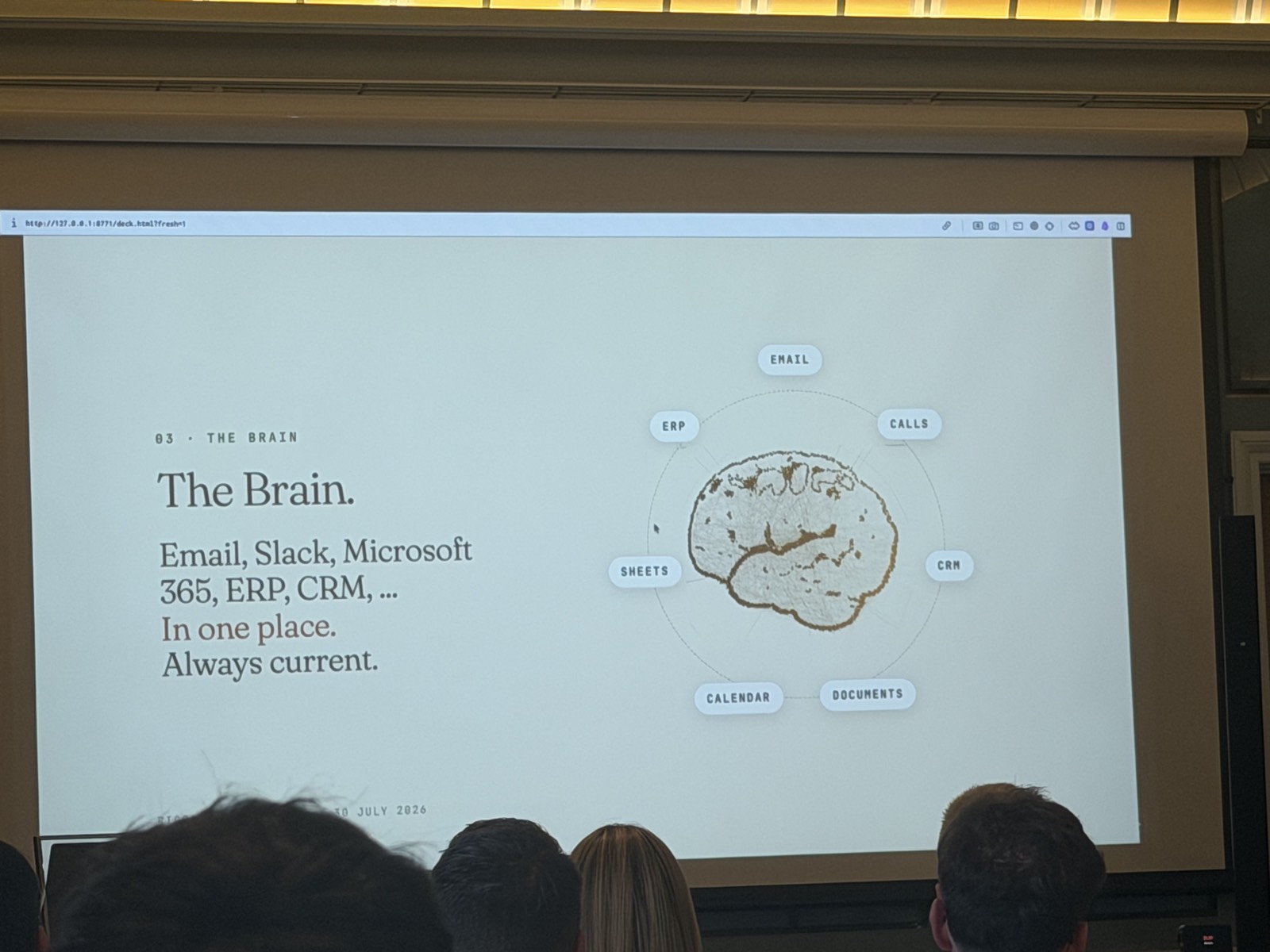
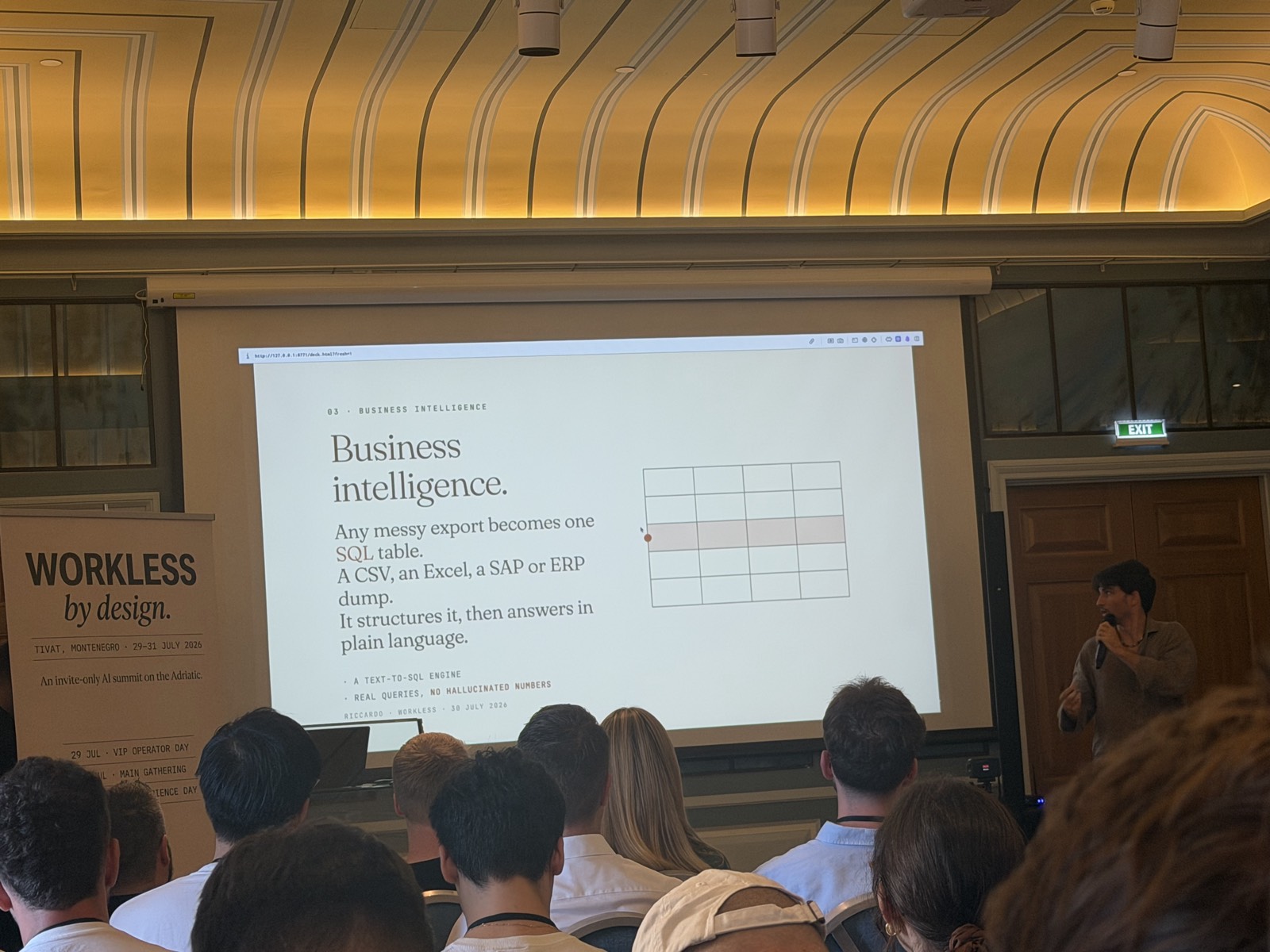
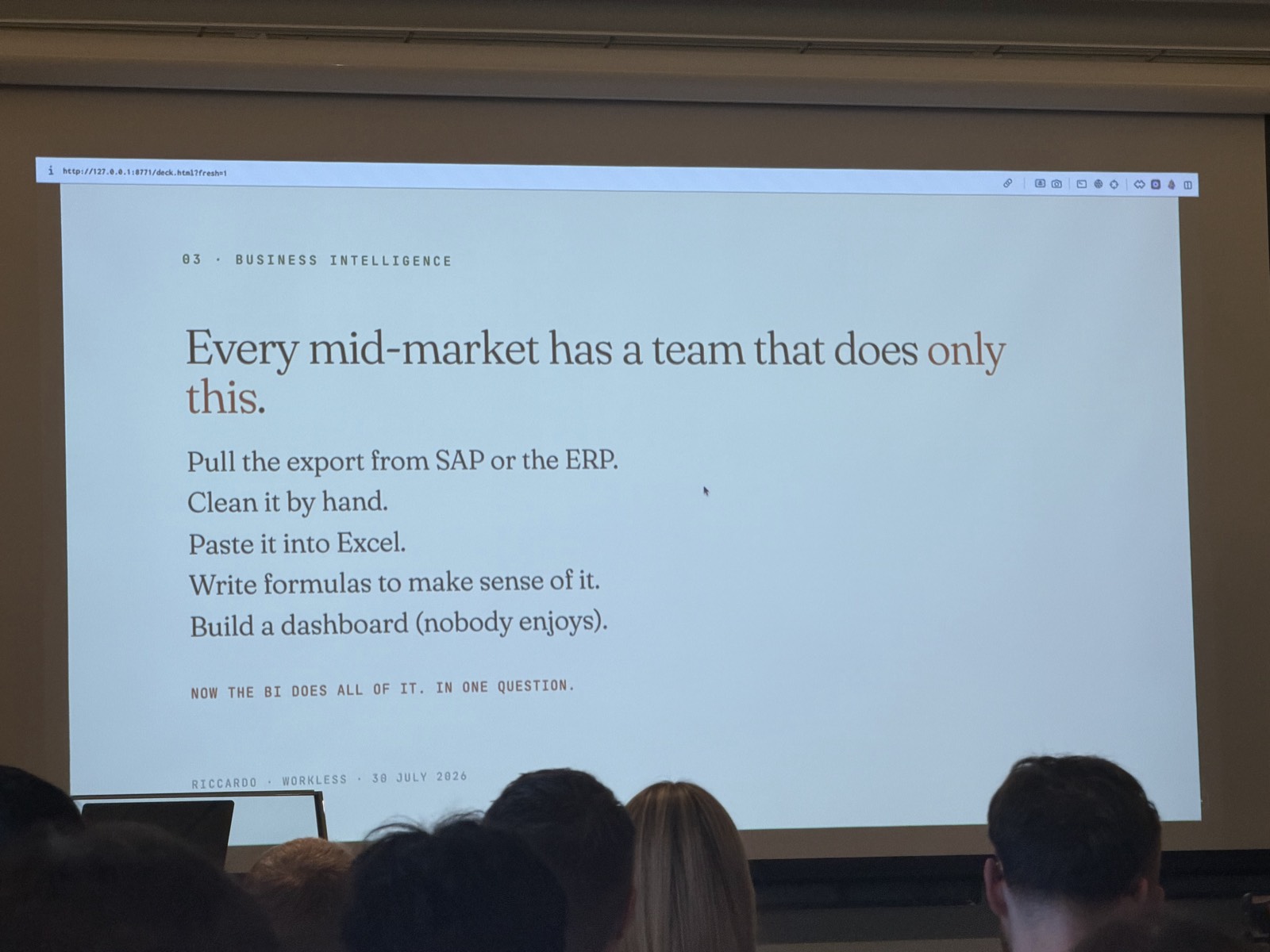
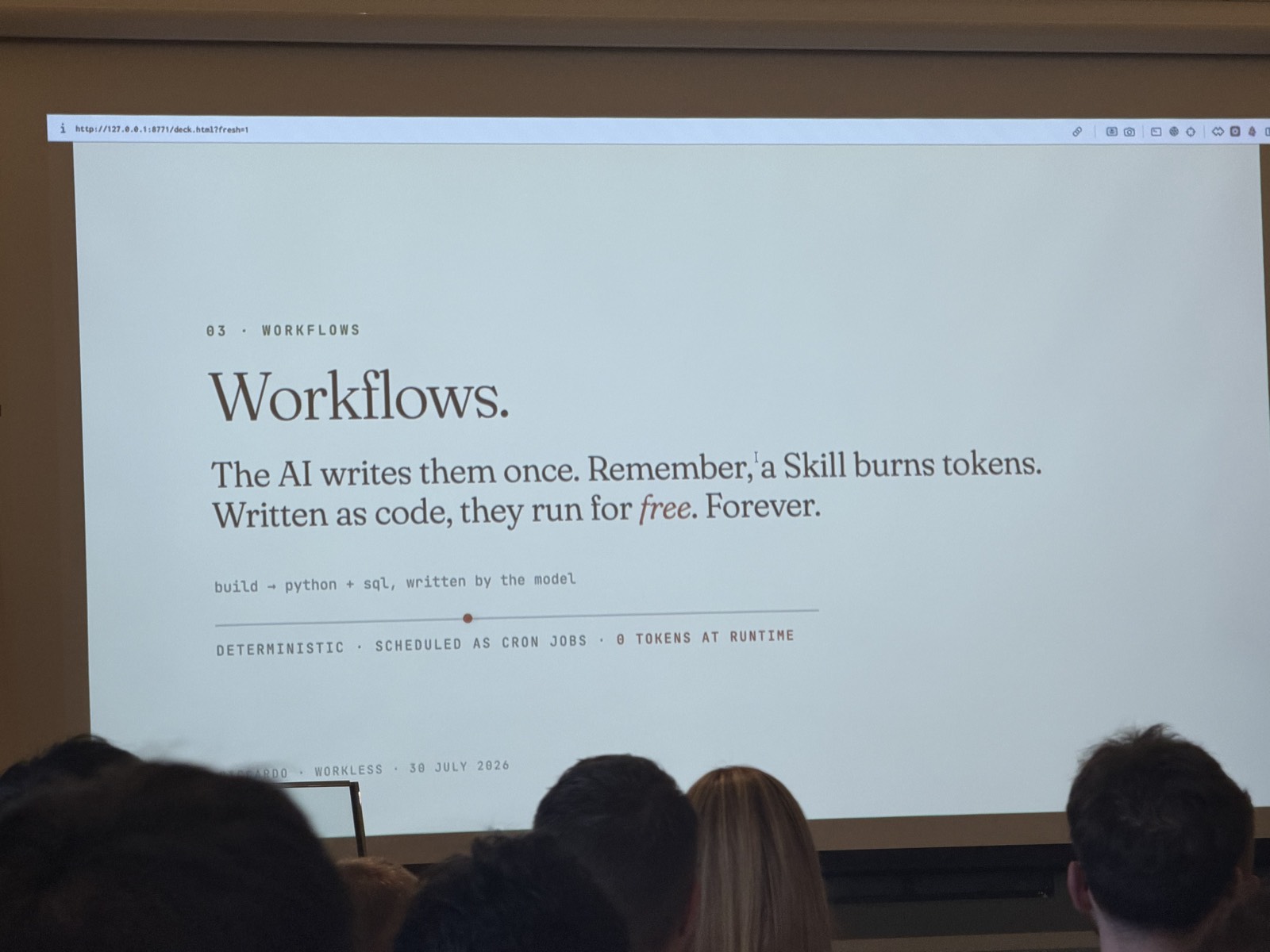
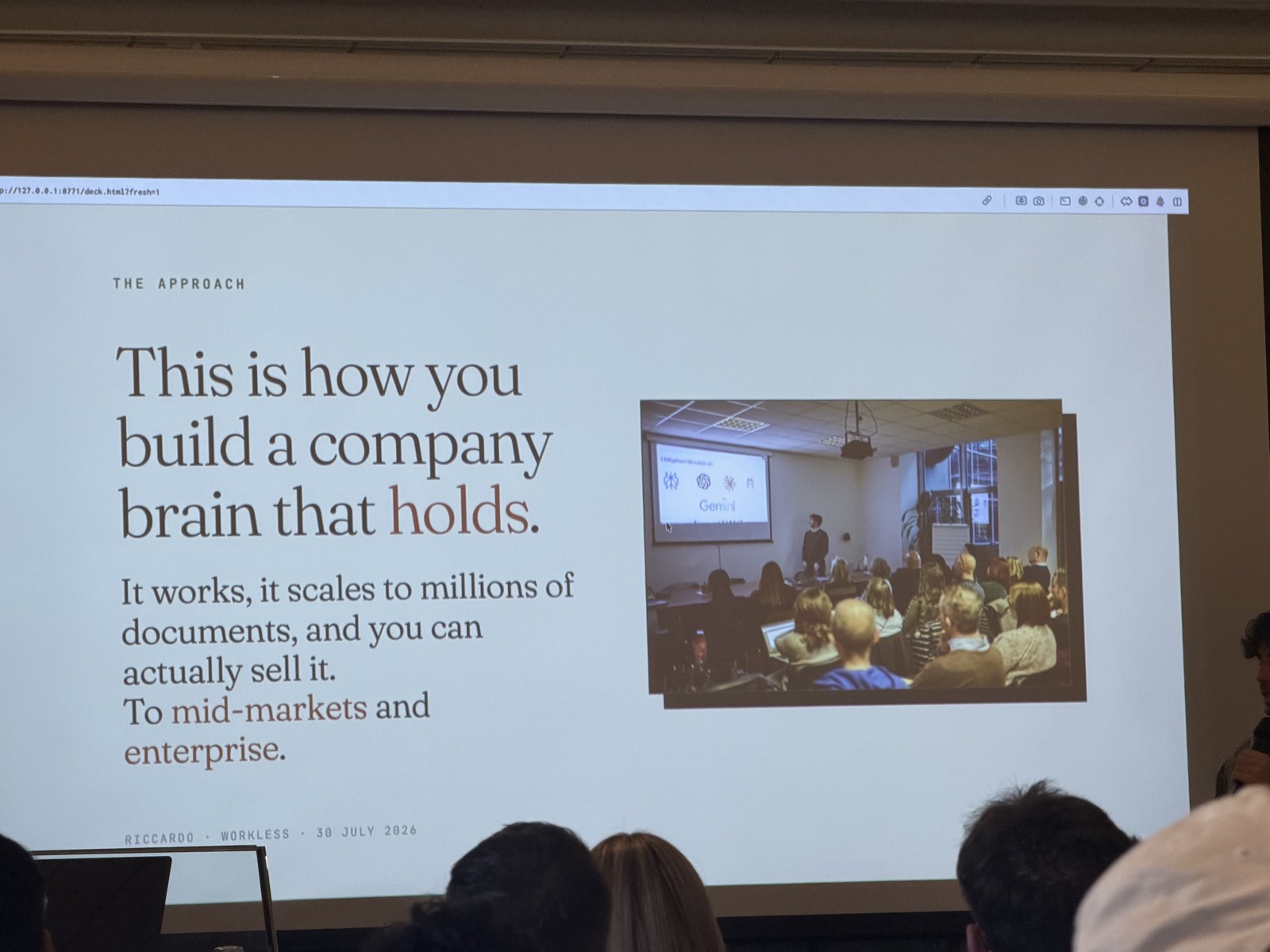
Why chat-first AI assistants break past about 30 users, and the three-part architecture that replaces them for mid-market companies: a document brain, text-to-SQL business intelligence over an enterprise ontology, and deterministic scheduled workflows that cost nothing in inference.
Key ideas
- EU enterprise buyers often reject hosted-LLM stacks on data residency before the demo; his clients "bring their own LLM" and pay for the system, not tokens.
- Quality must come from the system (ontology, SQL, deterministic routines), not the frontier model - model-agnostic by design.
- A chat-first brain degrades past about 10,000 documents and 40+ concurrent users (his figures); deterministic workflows make daily tasks free at runtime.
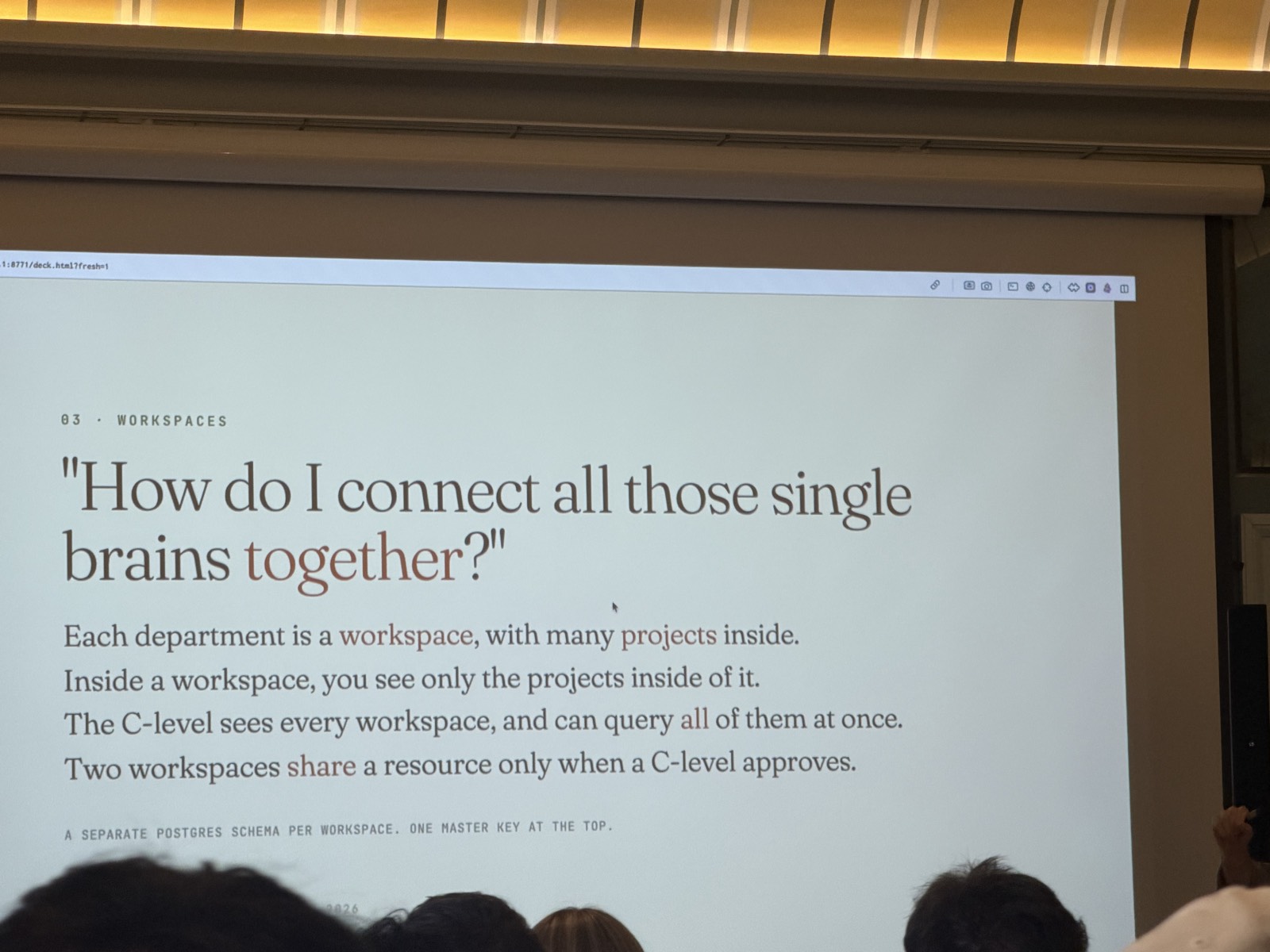
- Departments as workspaces, with the C-level federating across all of them - a clean permission model for multi-user setups.
- An honest ceiling: chat-first operating systems are "great for SMBs, but when it's more than thirty people, it's not enough" - past that you need the BI and ontology layer.
Slides (7)
Making companies AI-first
Bohdan and Adam
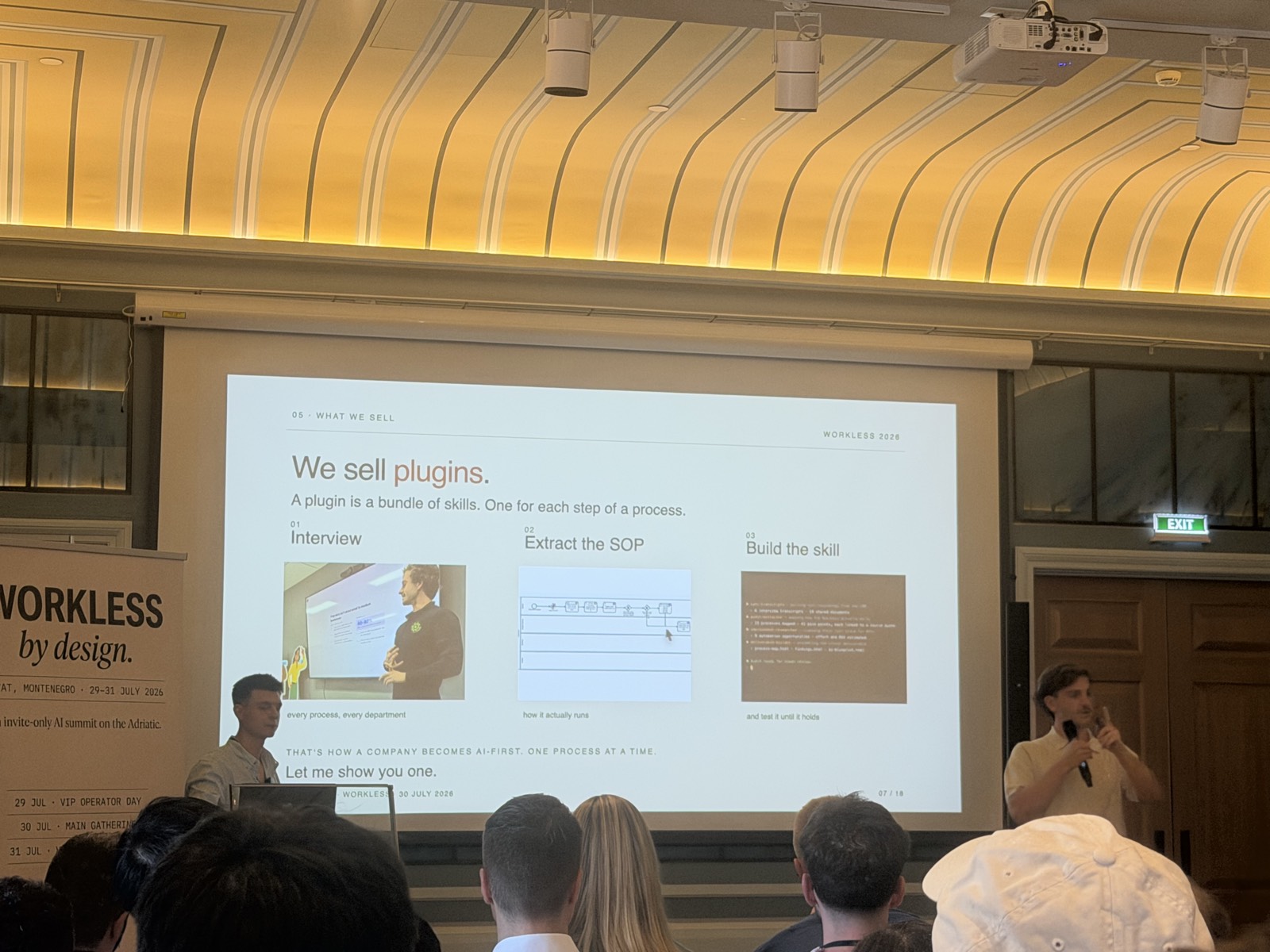
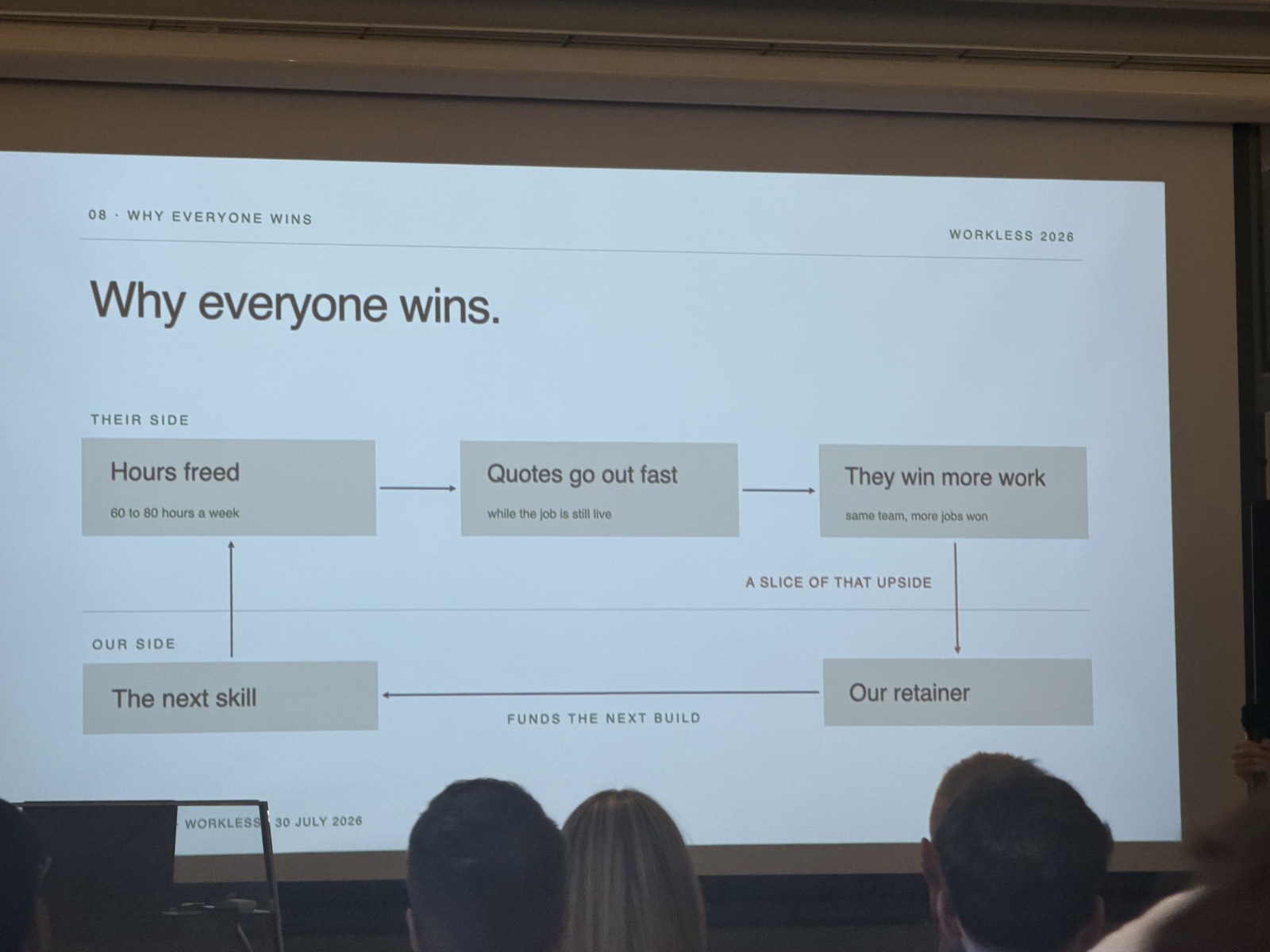
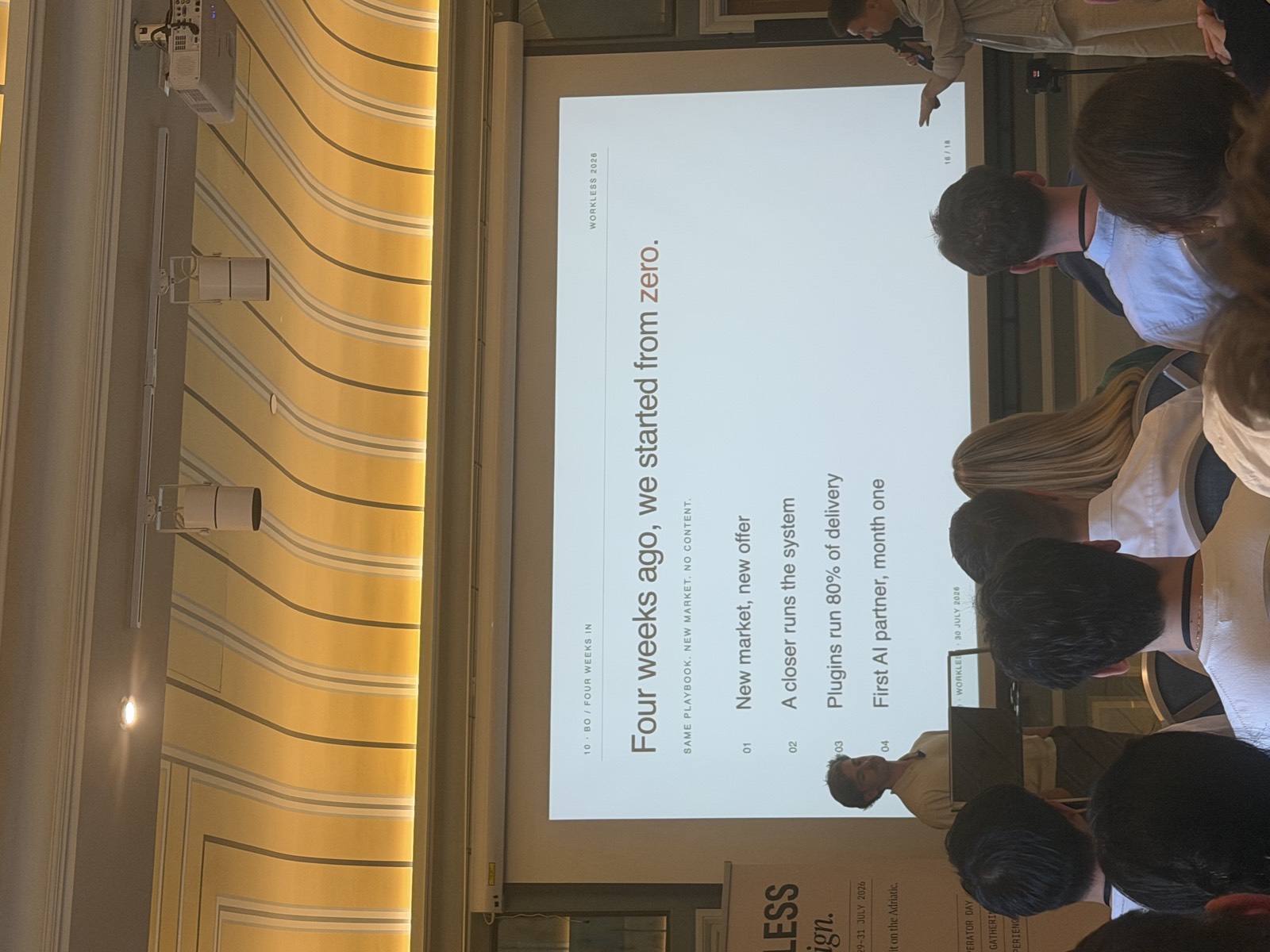
Two operators who productised agency delivery into installable skill bundles ("plugins"): process capture beats engineering, a skill is inputs plus rules plus tests, and the retainer is a slice of the measured saving.
Key ideas
- A plugin is a bundle of skills mapped to a departmental workflow; one 2-hour boardroom session with the domain experts can automate a large share of a 10-20 hour process (their claim).
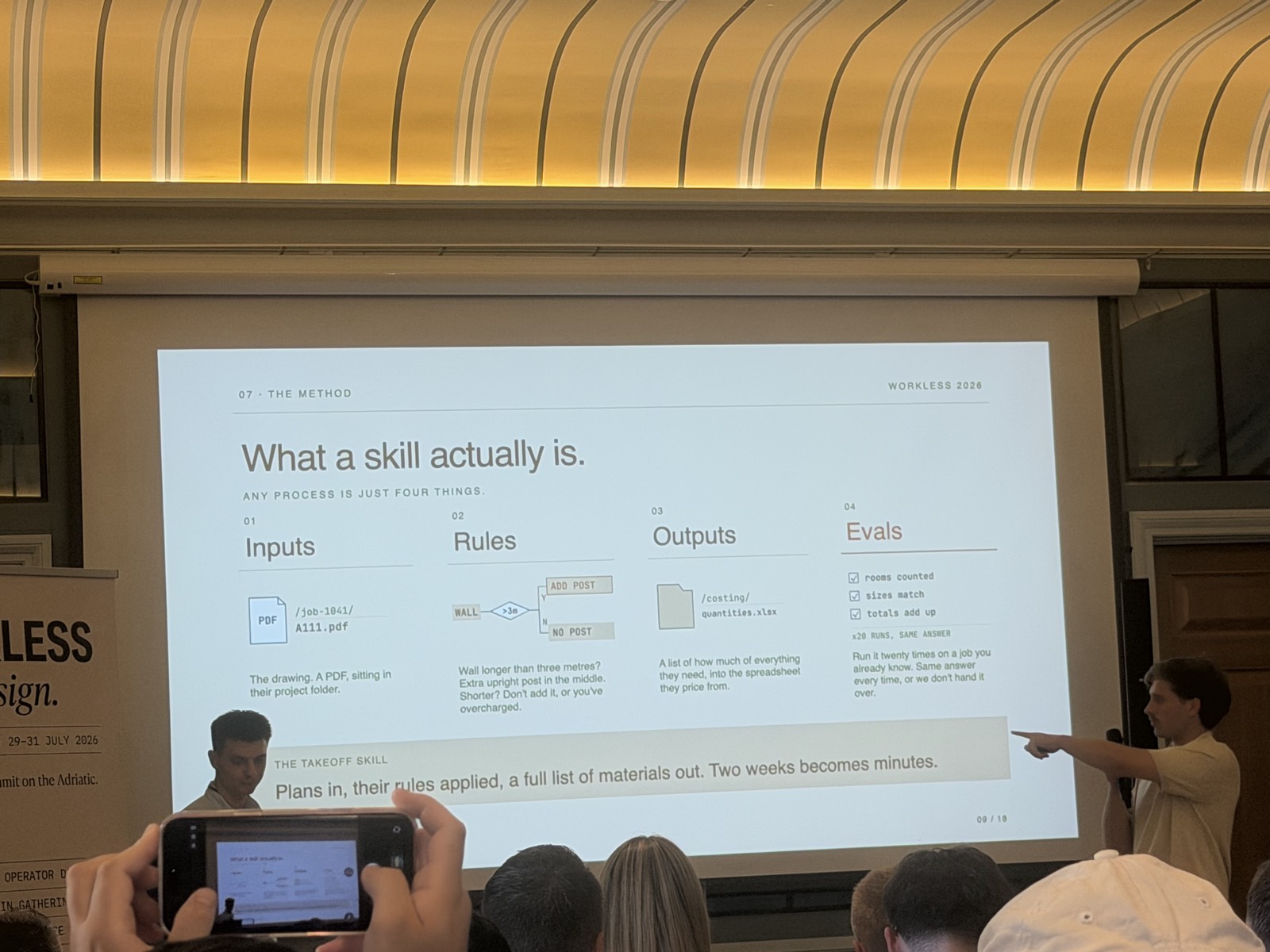
- A skill is inputs, rules, tests - validated with 20-50 isolated trials before it is trusted, because a misquote can cost hundreds of thousands.
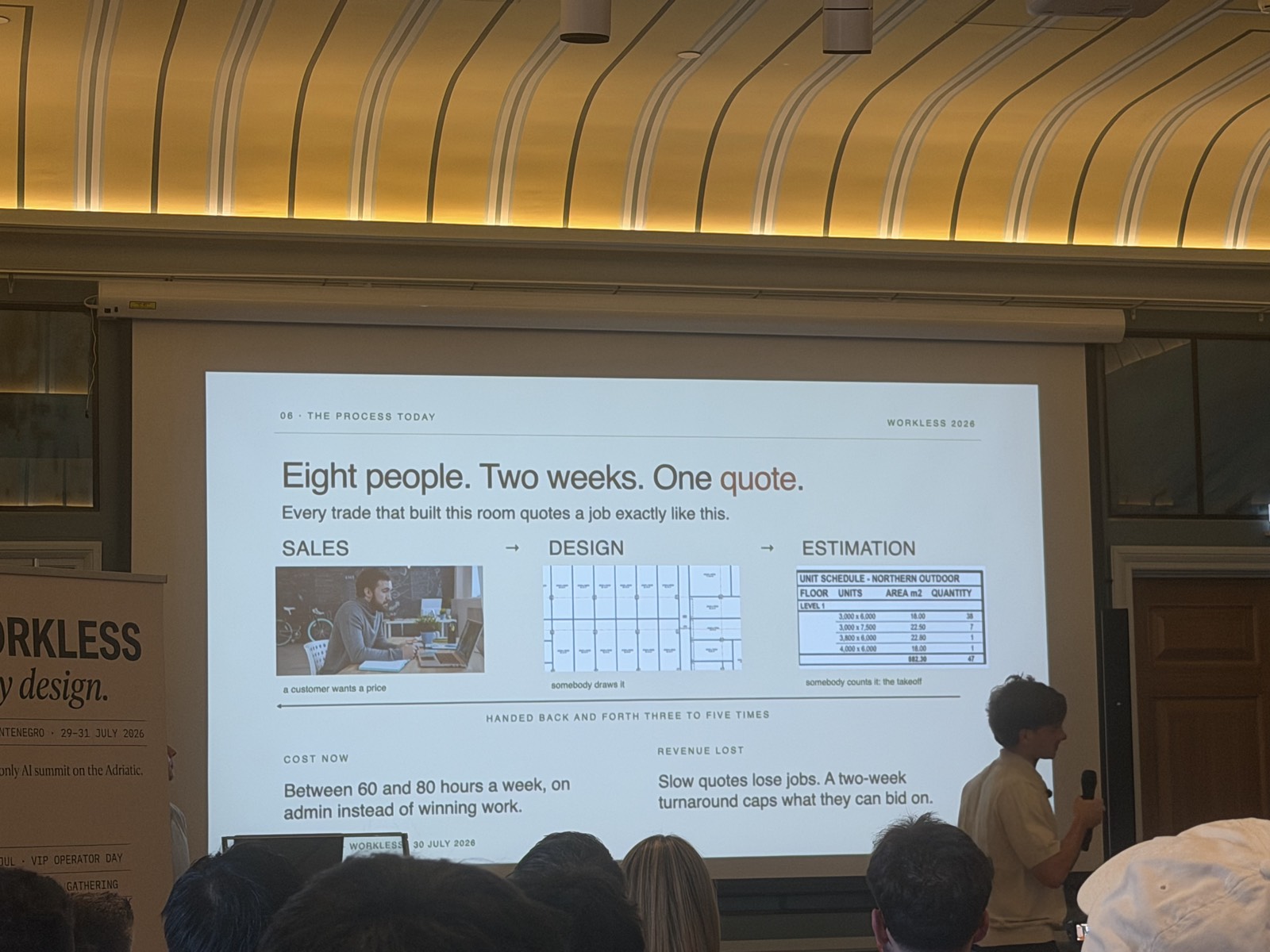
- Worked example: construction estimation cut from about two weeks touching eight people to same-day - faster quotes mean more won work, not just saved hours.
- The ROI sale: audit first to baseline hours, touches and cycle time, then "give me $1 now and get $2 back in two weeks".
- Traffic / System / Skill: every service business is bottlenecked by exactly one of lead generation, conversion or delivery at a time - diagnose the binding constraint and work only on that.
Slides (5)
What Big Companies Buy, and How to Build It
Ethan Monkhouse
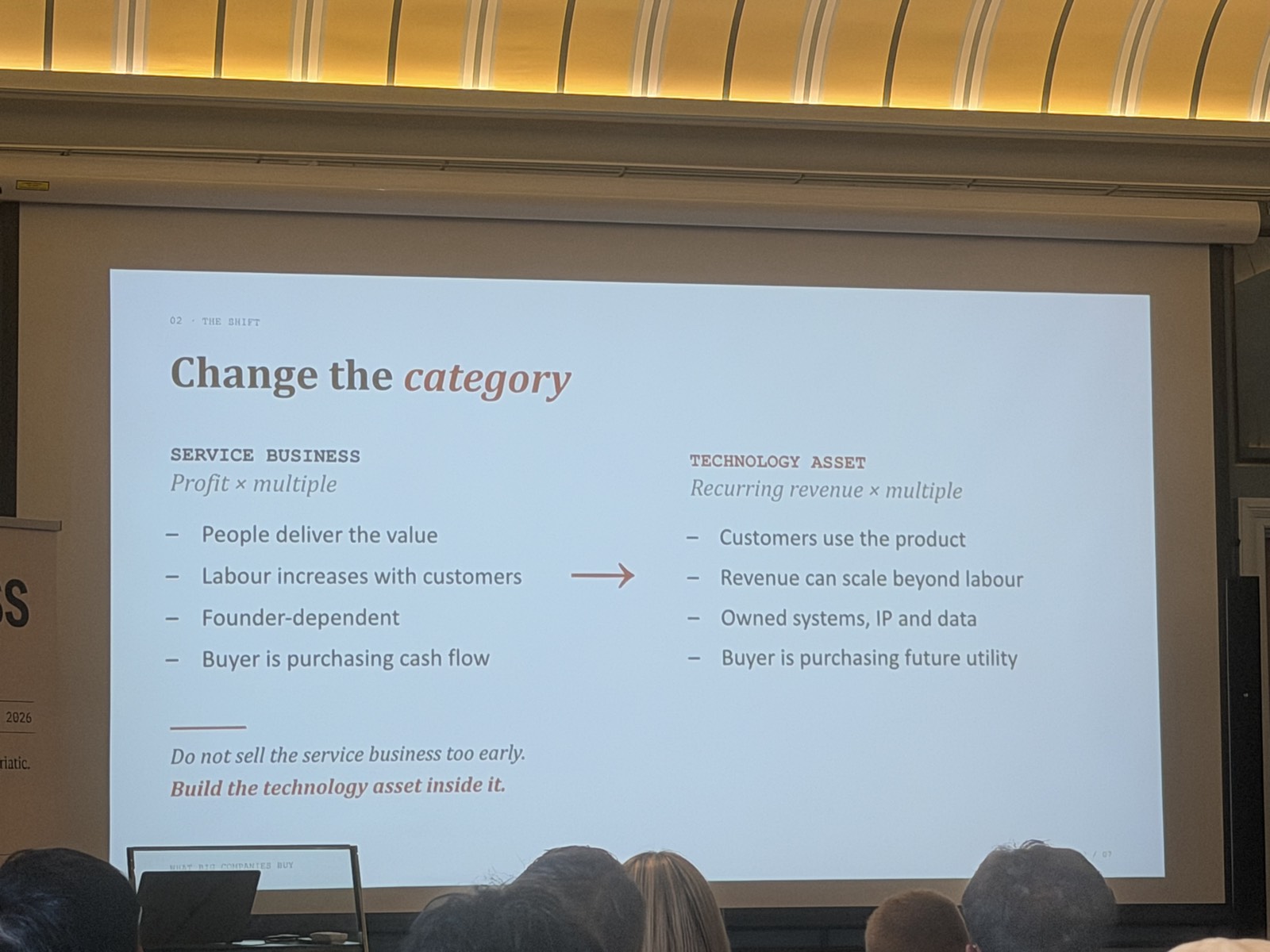
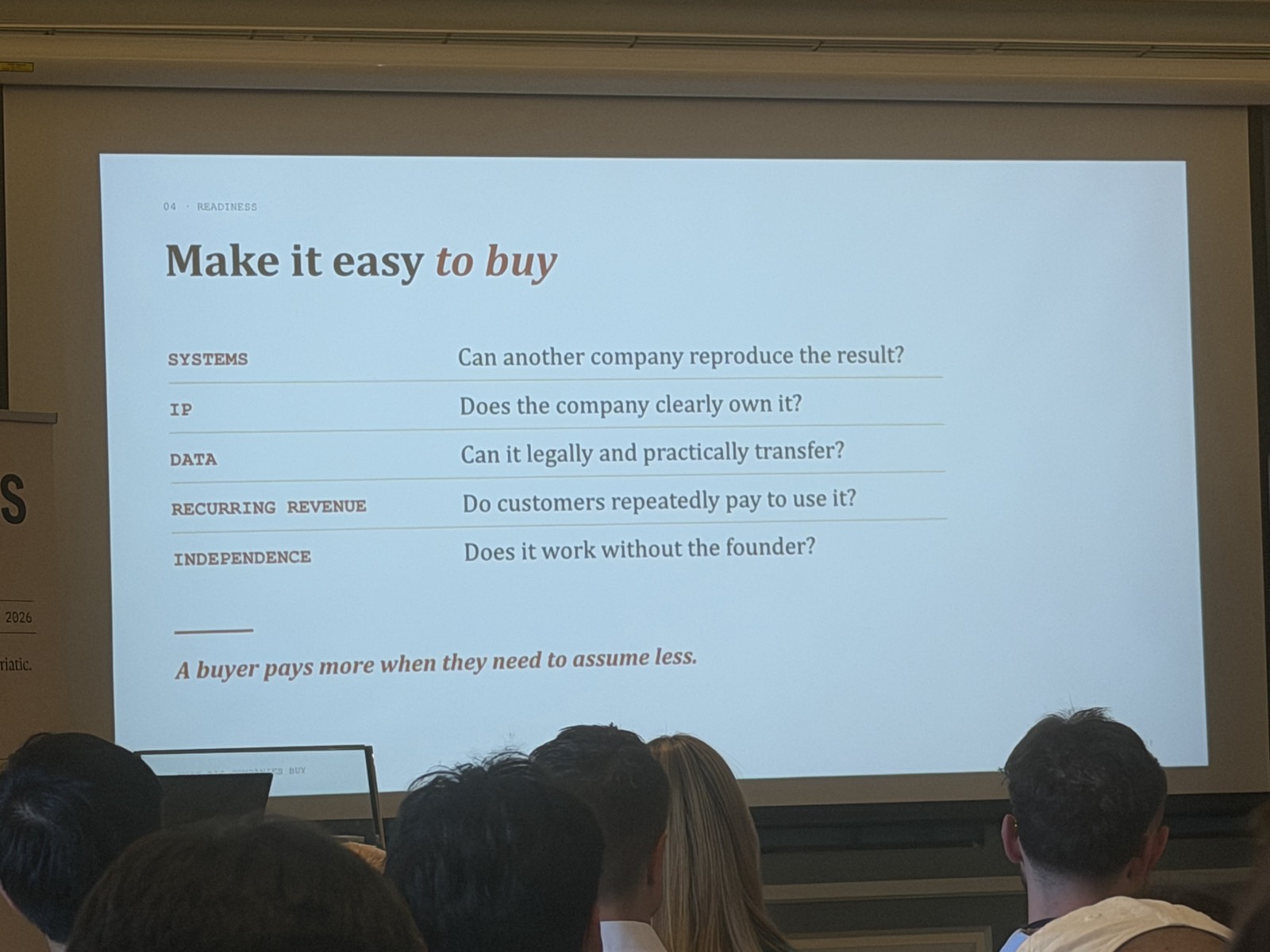
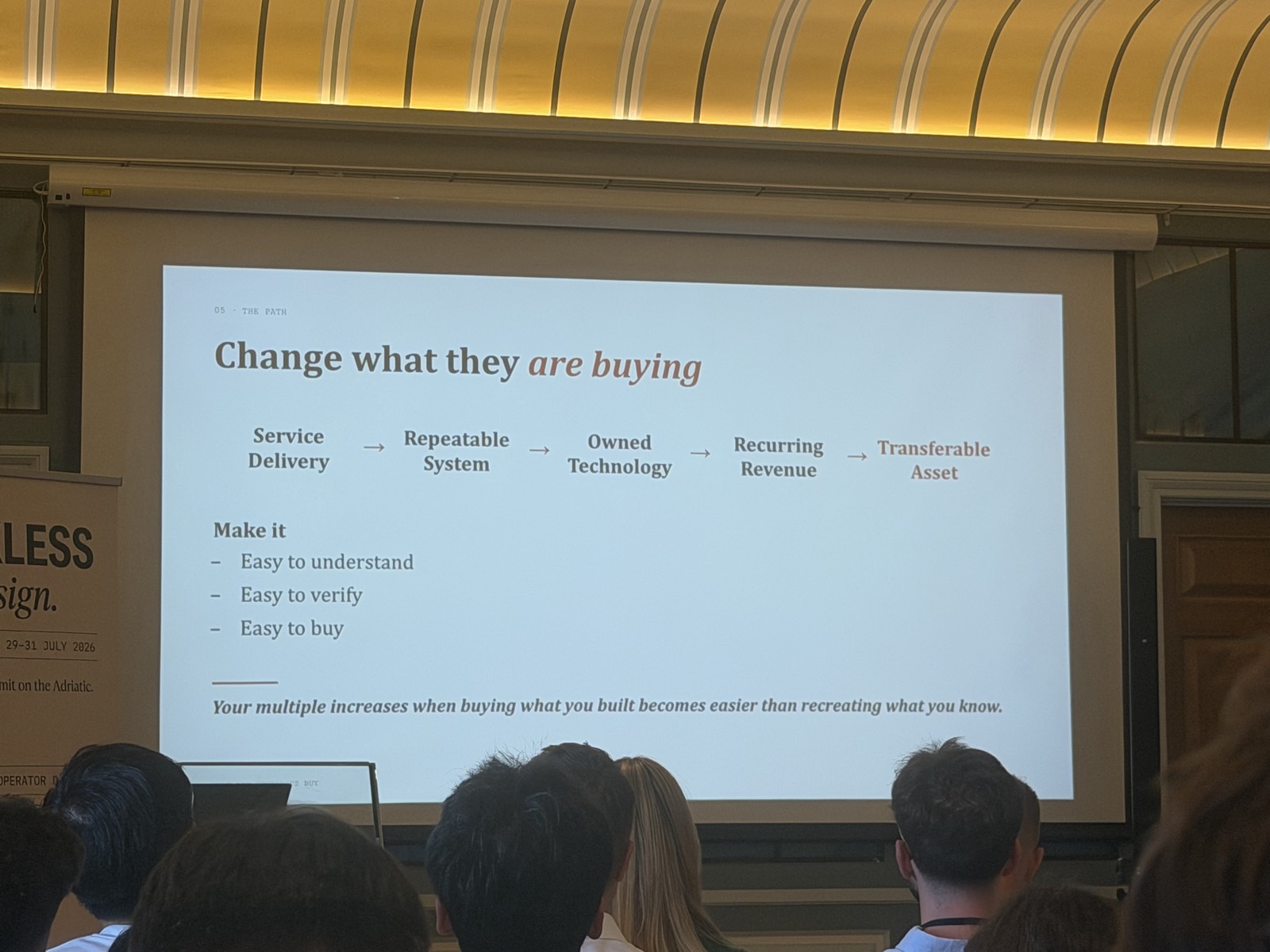
Why service businesses exit at roughly 2.7-3x annual profit, and how to break the ceiling: change the asset class, not the multiple. Package accumulated data and intelligence into a proprietary technology asset that is transferable and defensible.
Key ideas
- Grounding exercise: average monthly profit x 36 - that is the ceiling while buyers are valuing cash flow tied to human delivery.
- The escape: package your intelligence into a technology asset that is transferable (documented, a new owner can run it) and defensible (hard to recreate).
- "The multiple increases when buying what you build becomes easier than recreating what you know."
- Service firms beat pure software plays to product-market fit through warm client introductions.
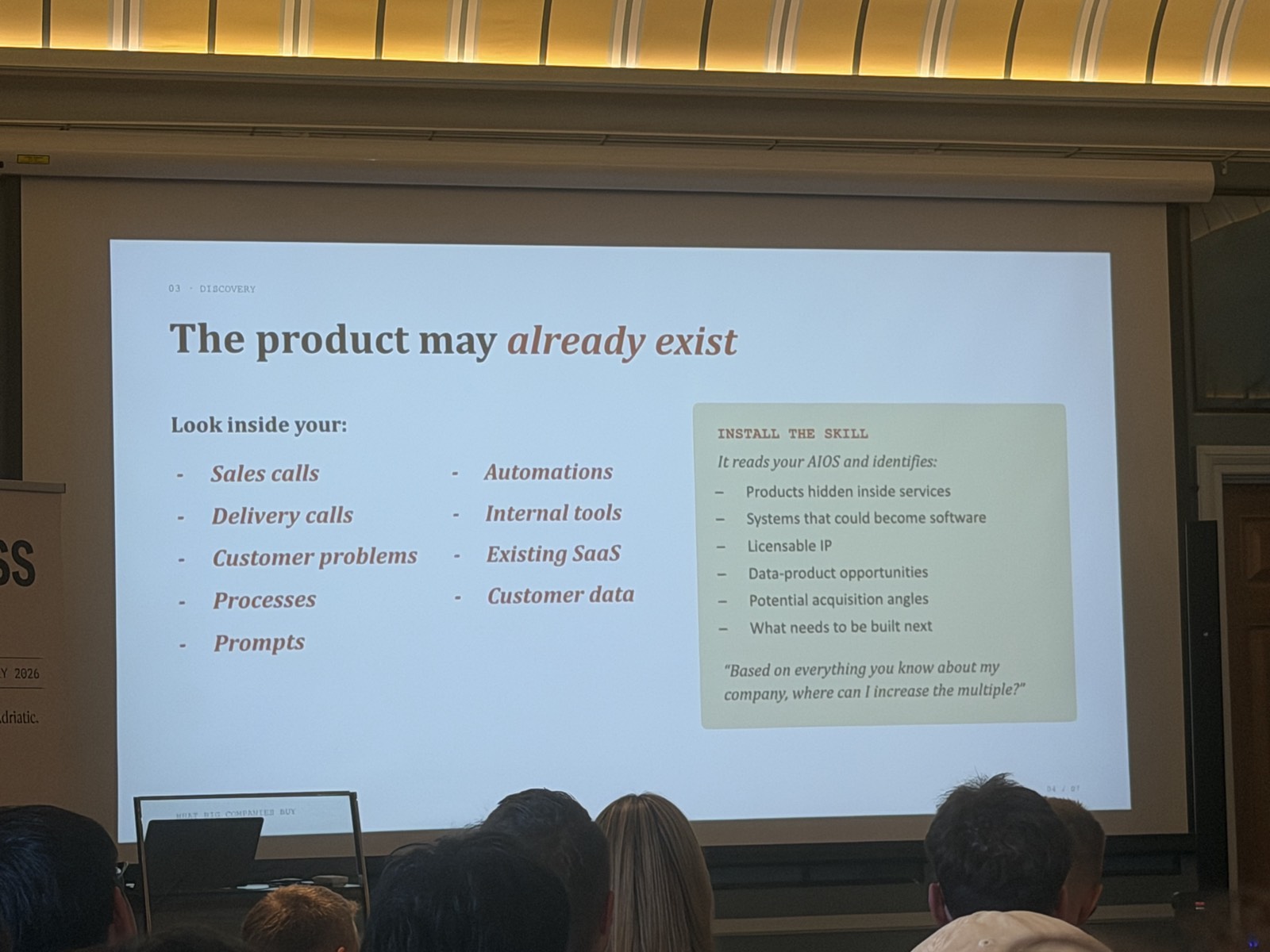
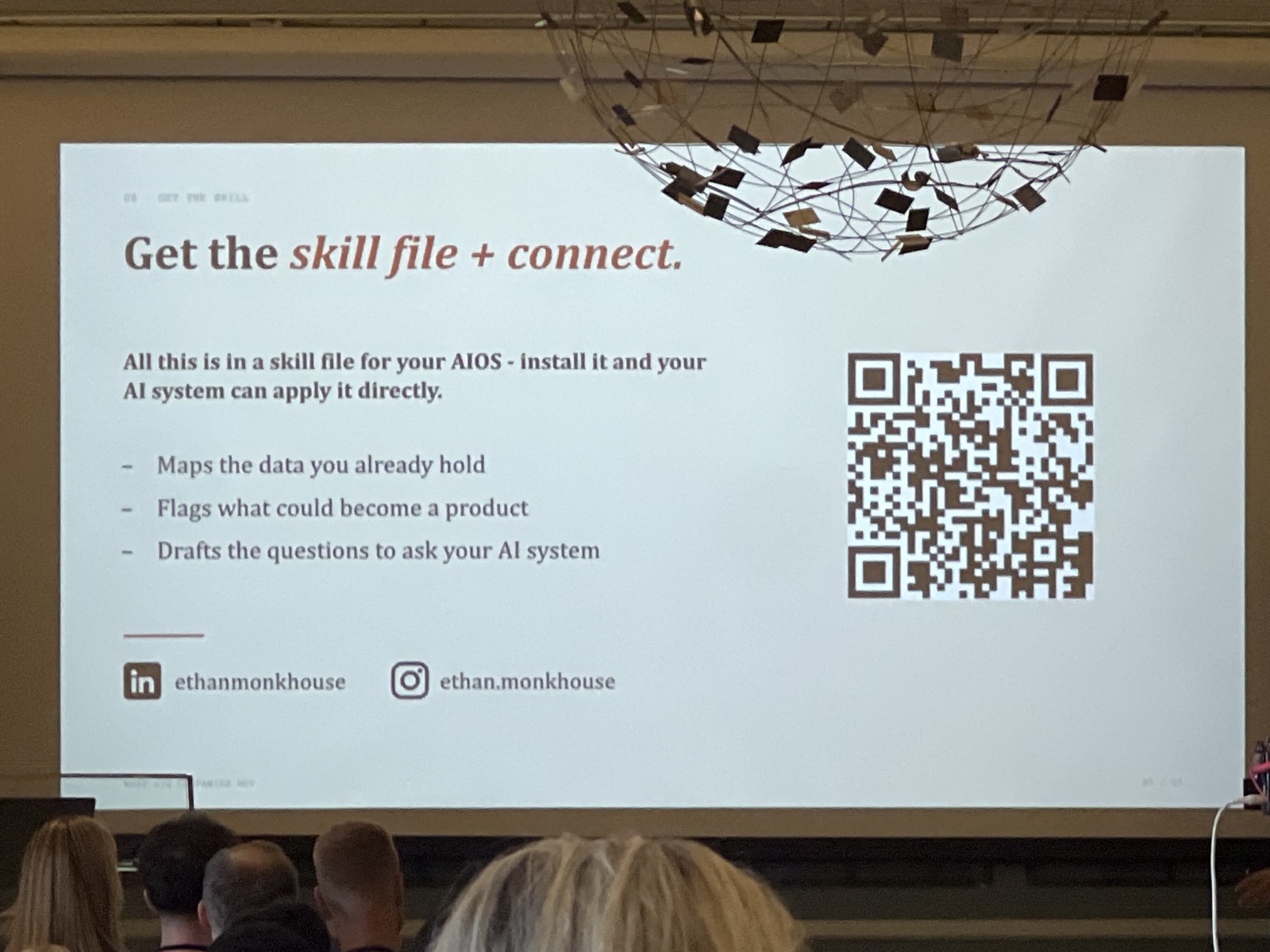
- He shared a working tool with attendees that reads your own workspace and identifies licensable IP and data products.
Slides (5)
AI won't replace you, it will expand you
Akil Wade
A closing morning session on authentic AI-driven content at scale: a content factory trained on his own scripts, a sponsor play built on showing brands their finished sponsorship before they pay, and a daily one-document sweep of everything that matters.
Key ideas
- Content factory: an agent trained on all his past scripts drafts in his cadence, and a director agent assembles a near-complete edit; he cited 5.6M views in 30 days without appearing on camera (his figure).
- Sponsor play: hundreds of personalised AI videos, his face plus each target brand's logo, showing sponsors what their sponsorship would look like. "Show them the end result before they pay."
- His daily "sweep": one document consolidating all inboxes, tasks and money, read before the day starts; three must-do items, everything else is noise.
- Core thesis: with everyone on the same models, authenticity is the only durable differentiator - AI distributes your original thoughts, it never generates them.
Slides (1)
How Hostinger runs without Hostinger in the room
Hostinger team
A walkthrough of Hostinger's internal AI stack: Dex, a Slack-native company agent with context, memory and per-employee dashboards, and Lumos, plain-English text-to-SQL - plus, refreshingly, the two things that failed.
Key ideas
- Dex use cases: a daily sweep of 70-80 competitors posted as per-product Slack summaries; screen-record a bug and Dex files the ticket and drafts the fix for human approval; most influencer research automated.
- Around 500 staff now have a personal AI agent (their figure); their 2025 goal of 50 automation-capable employees was beaten at around 100.
- What failed: unreviewed AI output shipped to customers caused complaints (now human-reviewed), and automated KPI-setting was reverted because it removed judgement.
- Education-first rollout: workshops, learning hubs, and an AI champion per team.
Building Glaido in public
Dave, Jannis, Jack and Nate (Glaido)
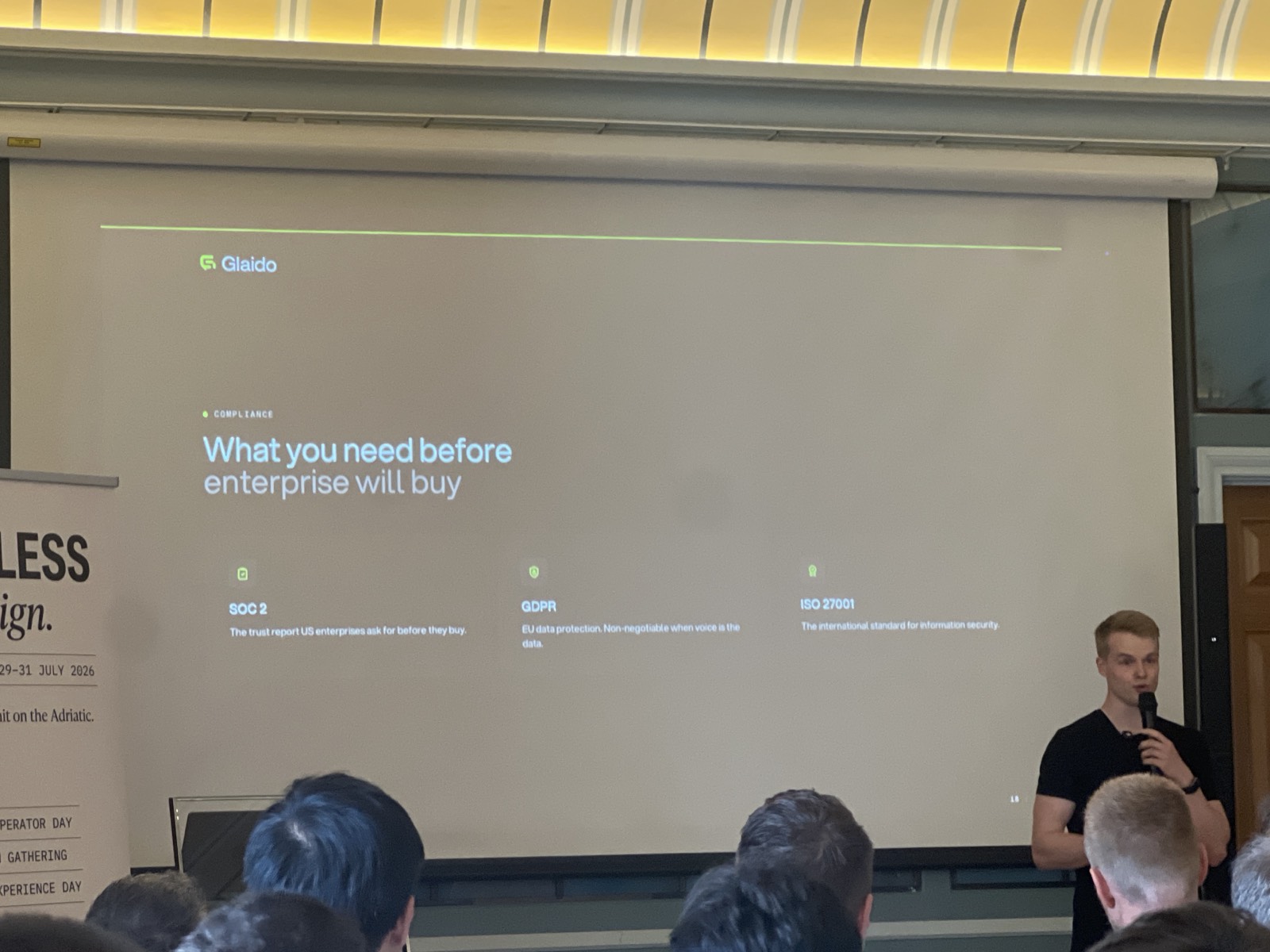
The team behind Glaido, a fast, private, EU-hosted dictation tool and conference sponsor, on building the product in the open: component-level design systems, feature-creep discipline, waitlist pre-validation and compliance as a moat.
Key ideas
- Design systems past brand guidelines to component-level definitions (button states, hover) so AI tools build pixel-perfect UI - "do it once even for internal products".
- Waitlist as the demand test: "if I can't get 300 people to say they want this, how am I going to sell it?"
- Feature-creep discipline: they experimented with about 20 features and shipped almost none - "we first really need to do one thing right".
- Compliance as moat: understand compliance deeply enough to automate it, so you can sell into enterprises without adding headcount.
- The product processes data without storing it, with an on-device layer in development and one-click dictionary import - switching is cheap.
Slides (1)
The AI automation playbook for agencies
Jack Roberts
Jack Roberts on the systems agencies actually use to deliver with AI.
Scaling client acquisition with AI
Serdar and Emil
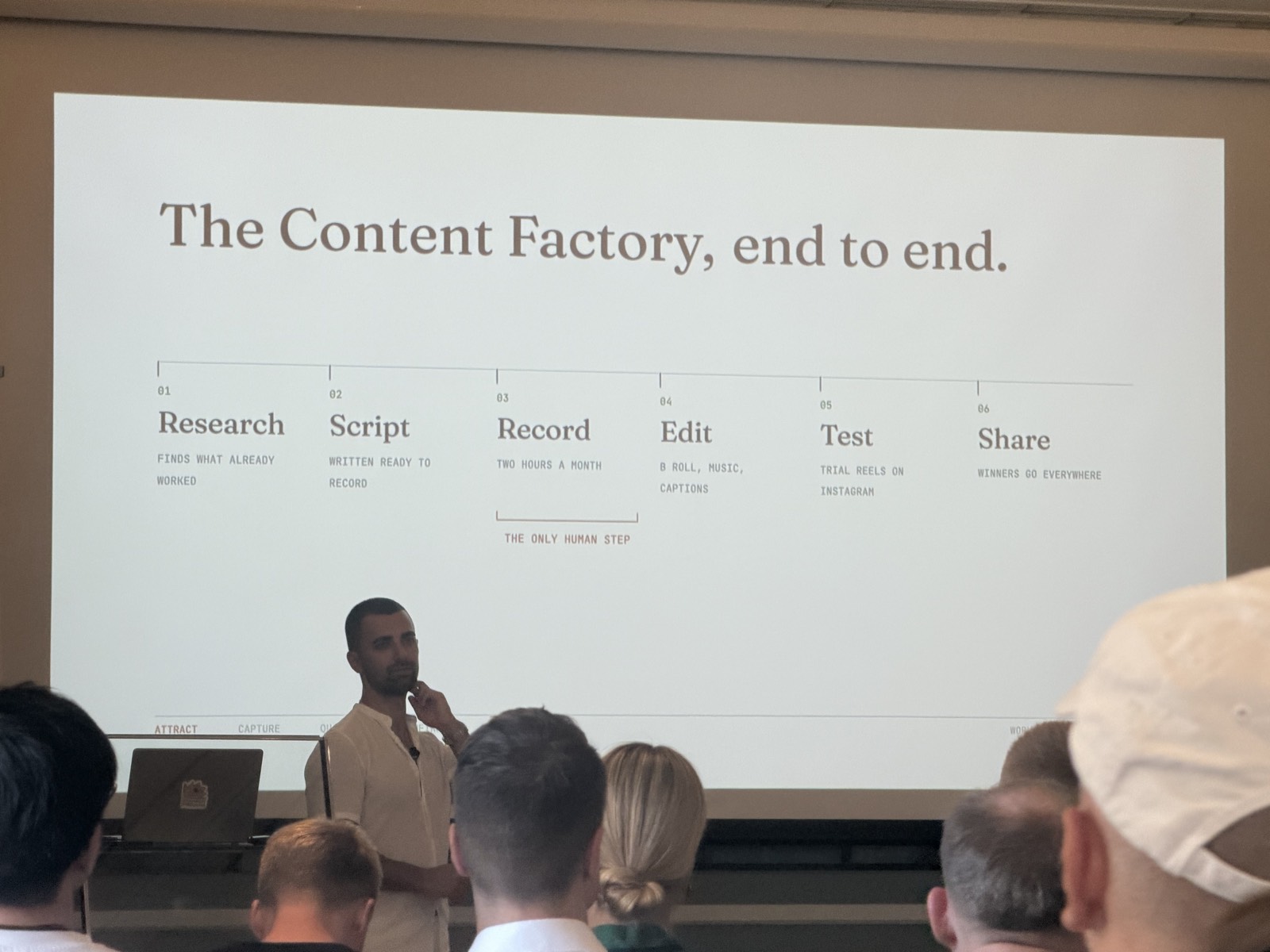
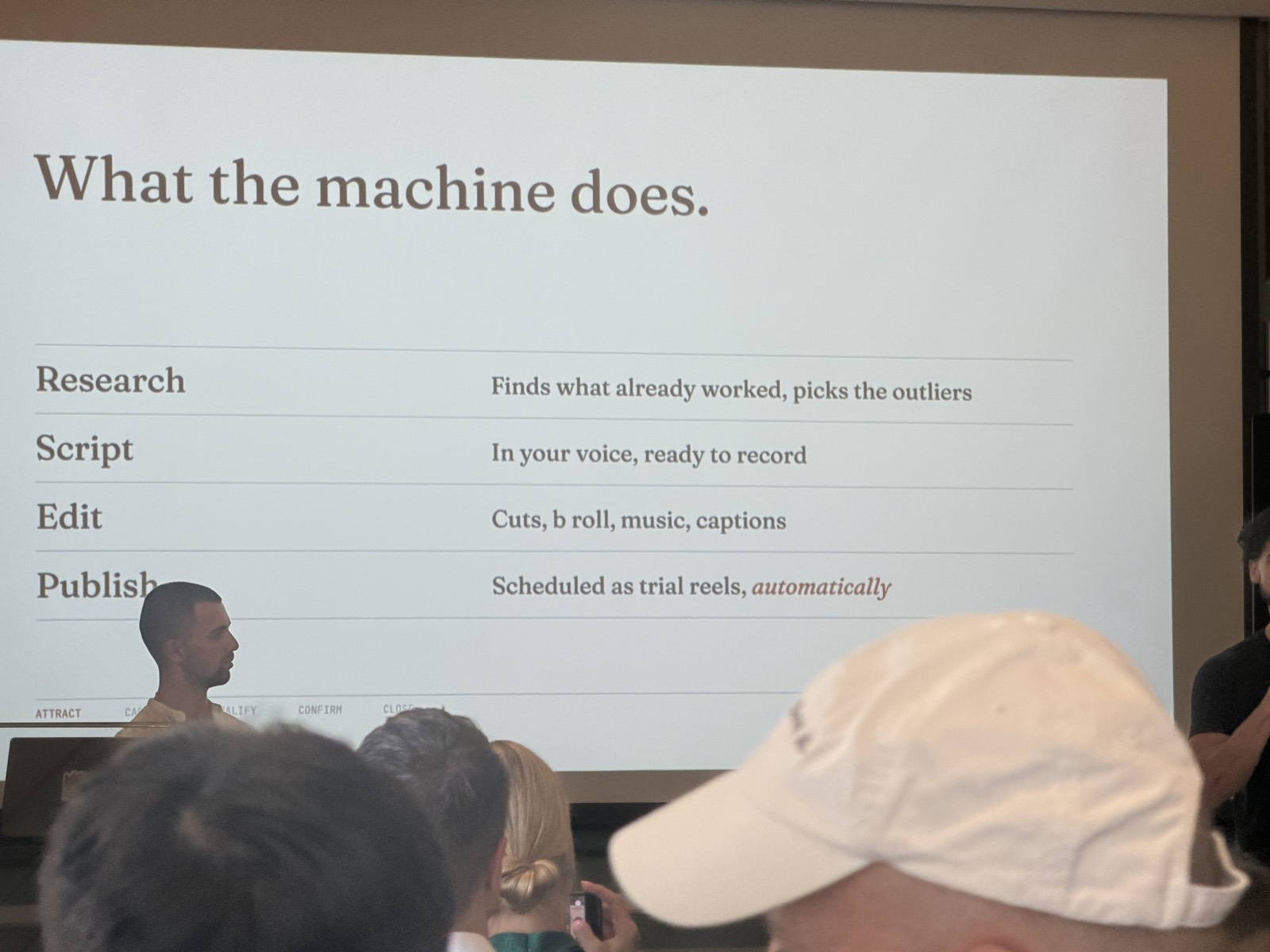
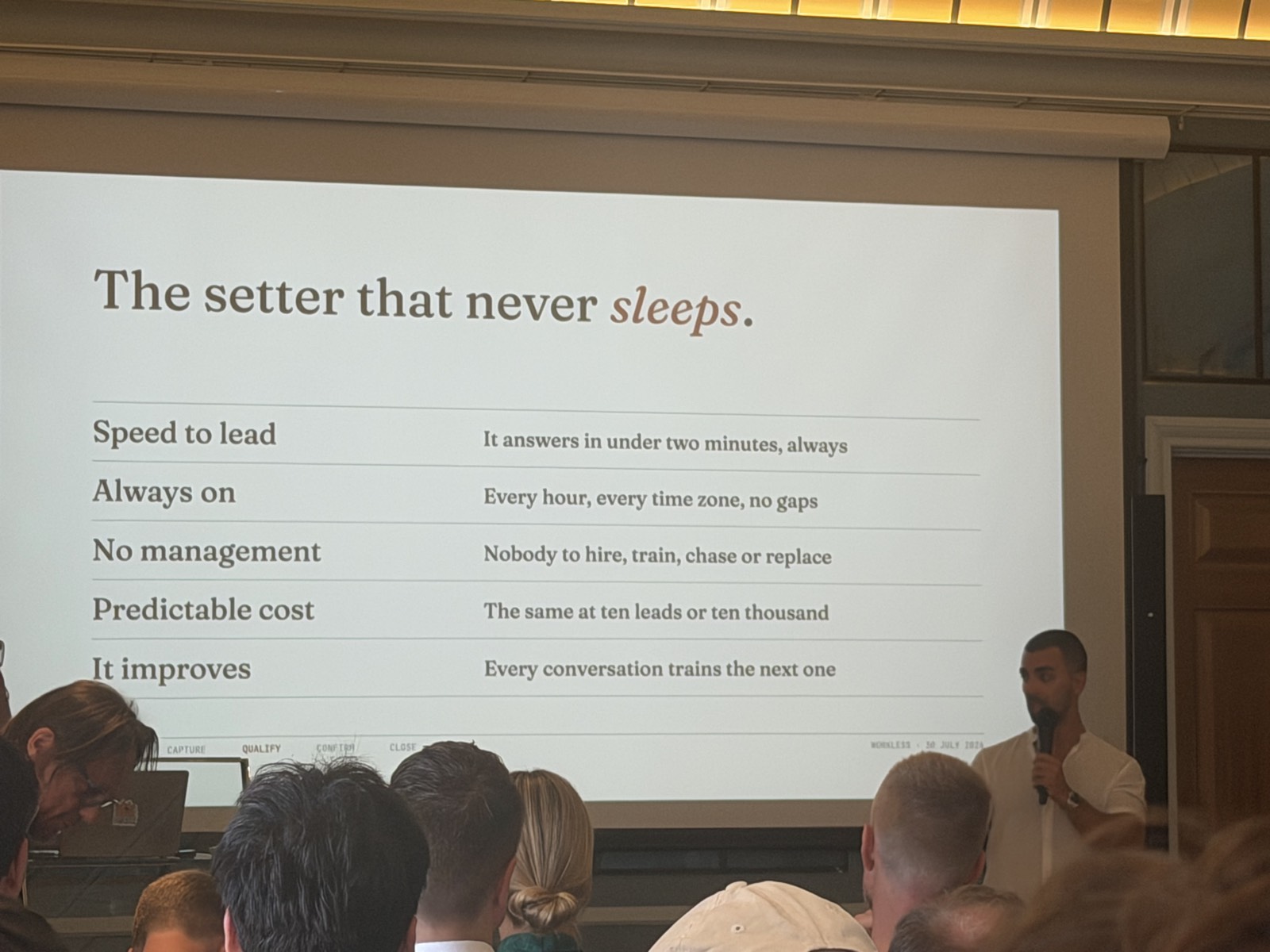
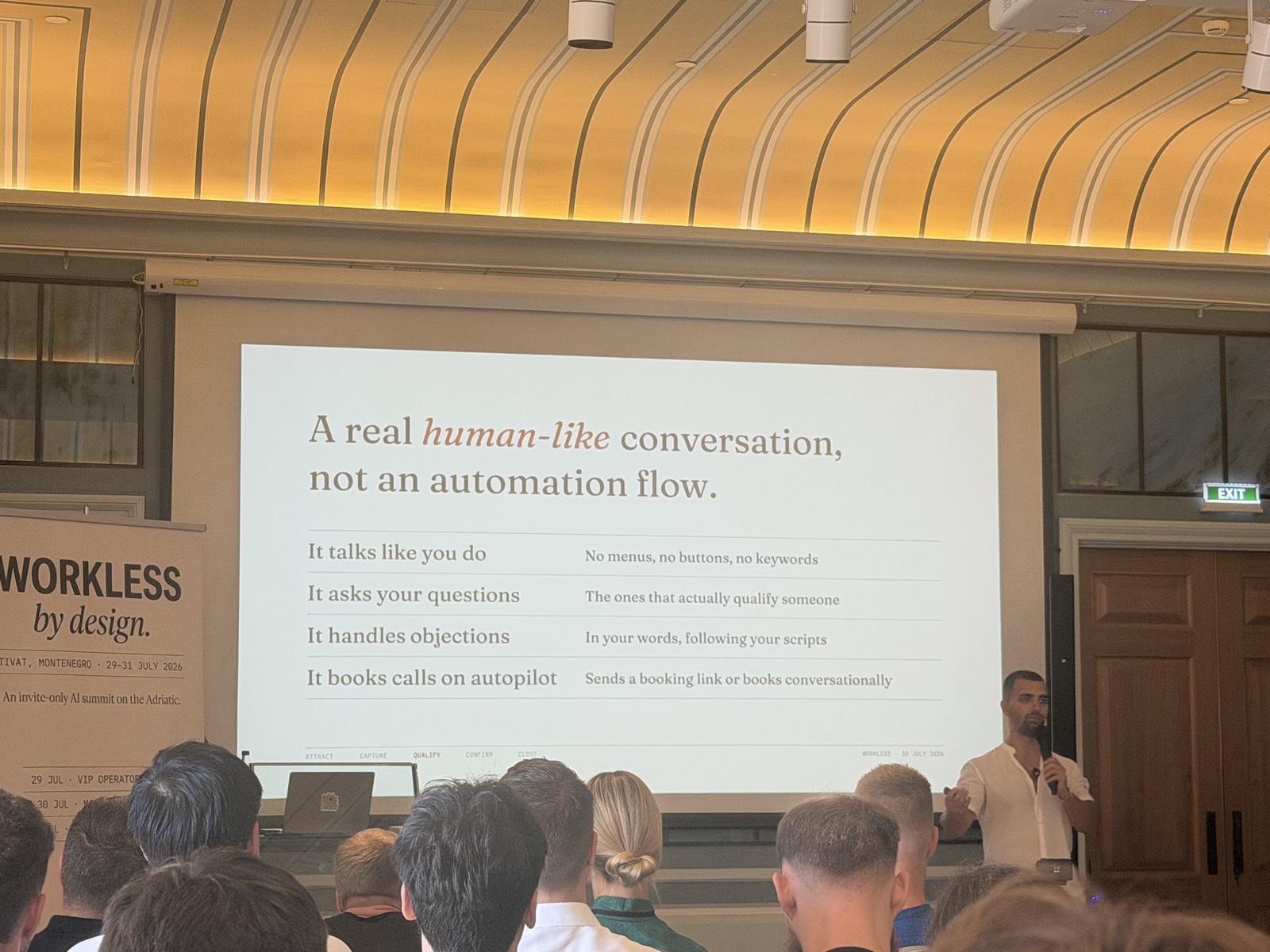
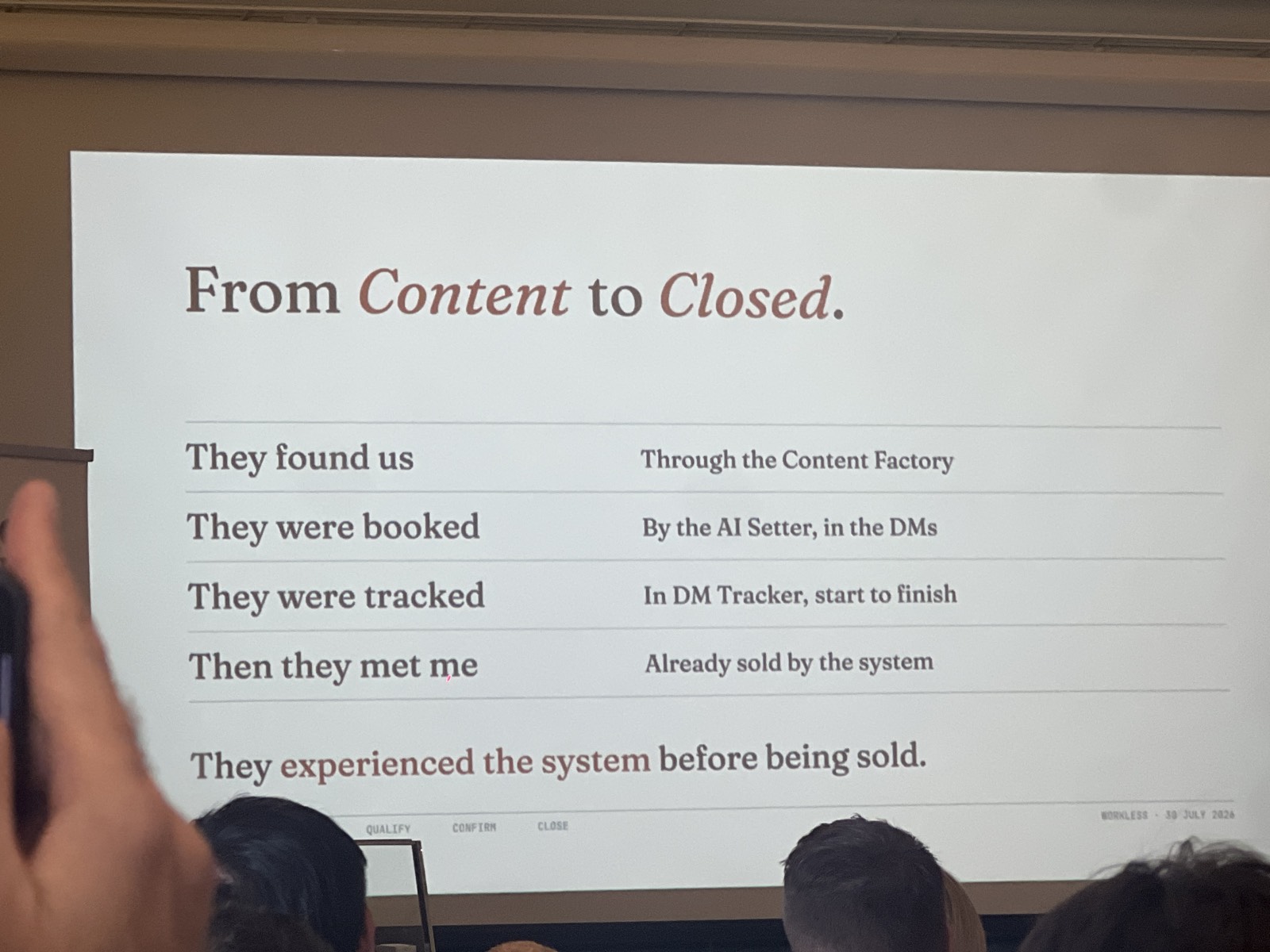
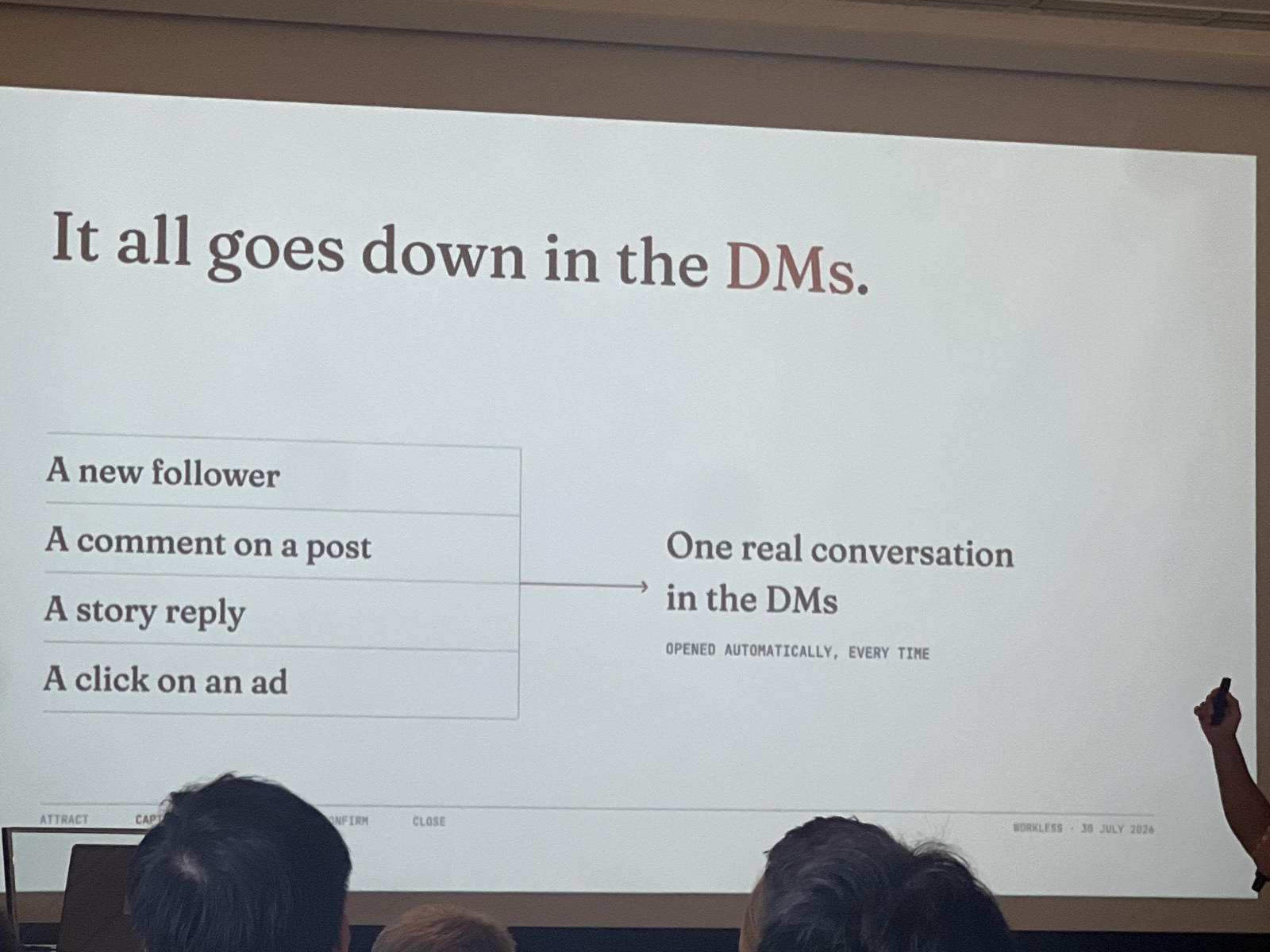
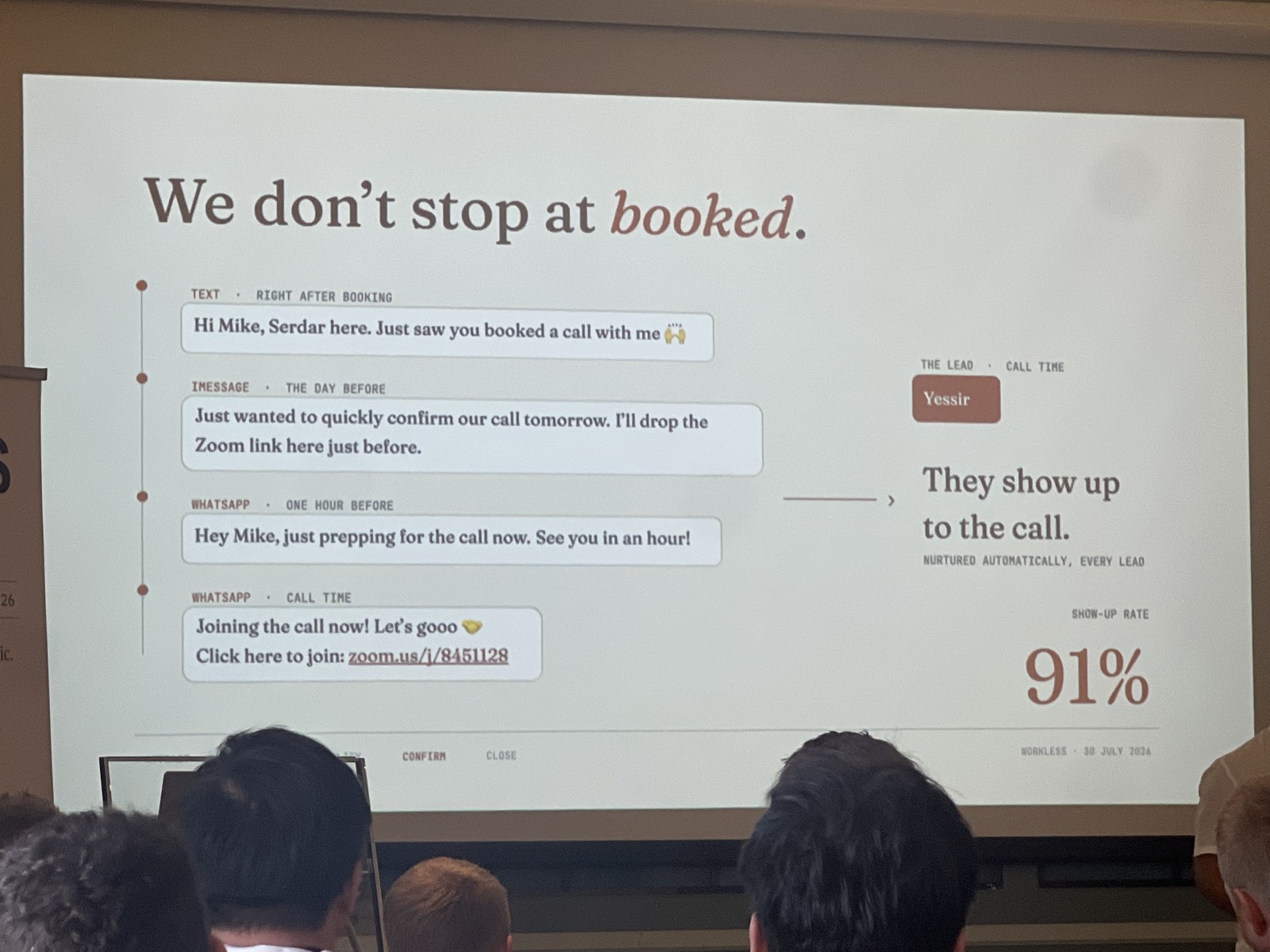
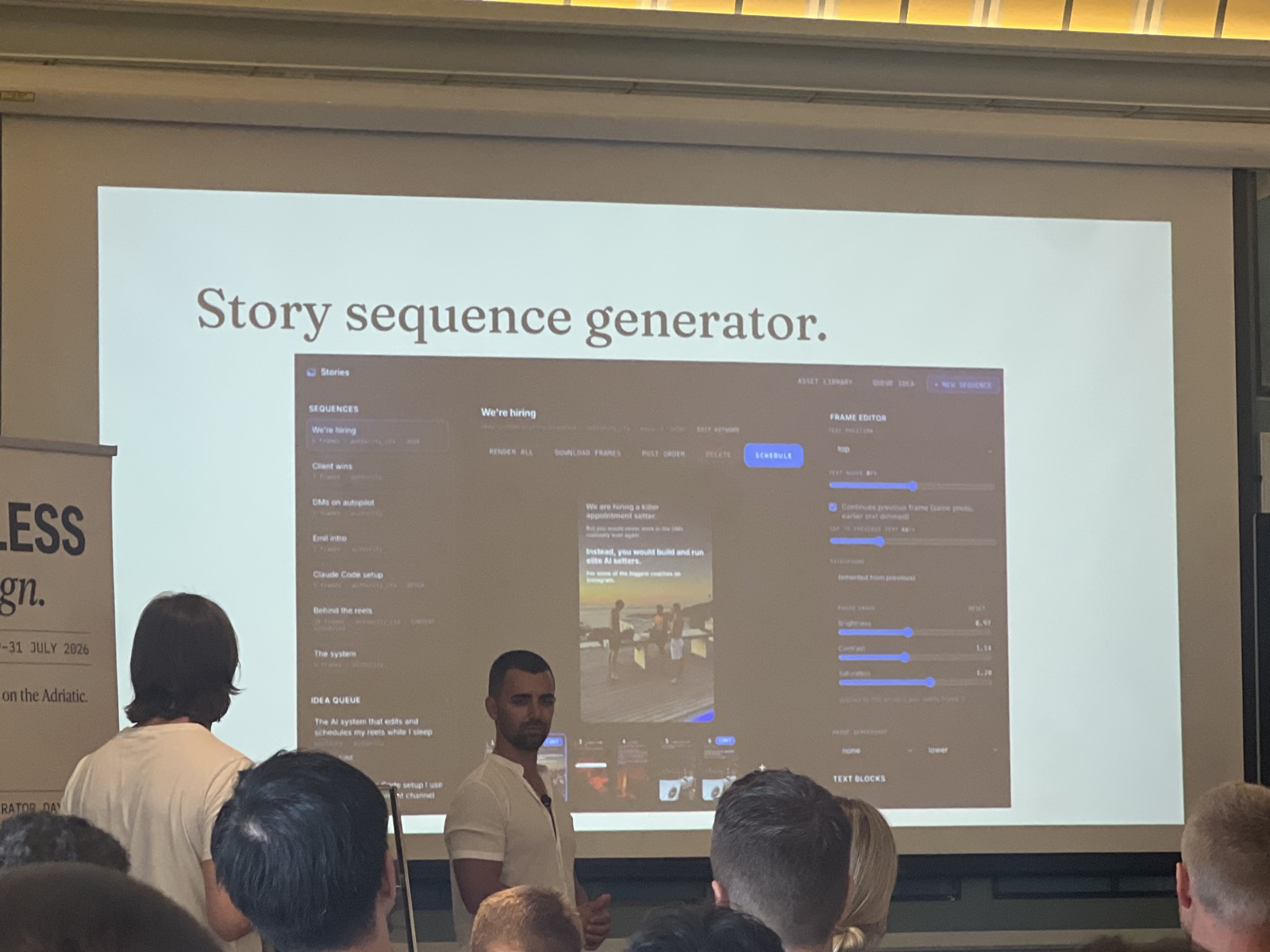
Two co-founders of a done-for-you Instagram acquisition agency for high-ticket offers: a full-funnel machine with exactly two human touchpoints - recording the content and taking the sales call. They shared a skills pack with attendees.
Key ideas
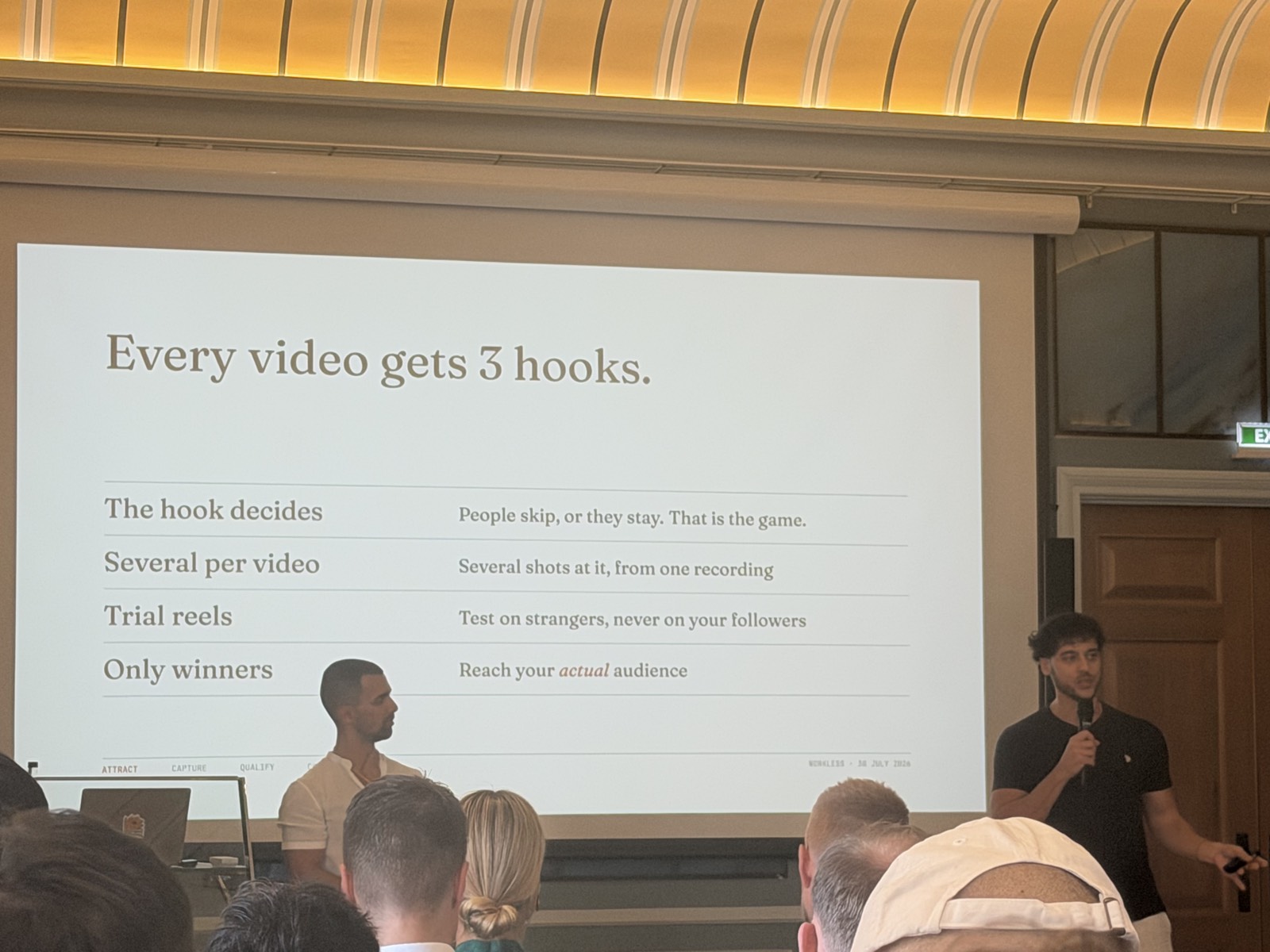
- Content factory: finds outlier competitor posts (5x average views), scripts in the founder's voice, and A/B tests three hooks per video via Instagram trial reels before promoting the winner.
- Ads only amplify organic content that has already proven itself - never cold creative.
- AI DM setter: speed-to-lead under 20 minutes, every engagement triggers a conversation; they say almost no leads clock that it is AI (their figure).
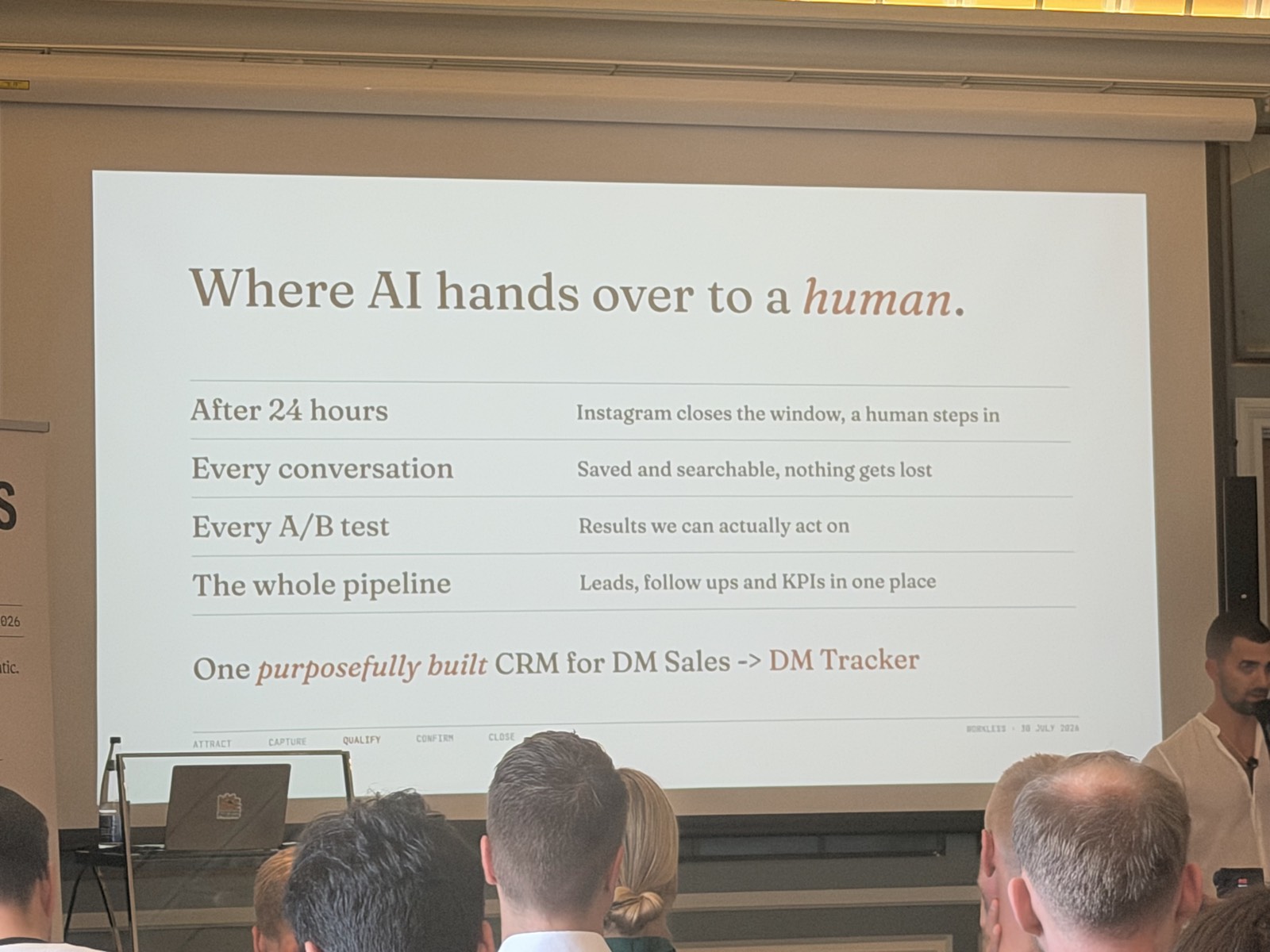
- Where the AI stops, the CRM hands a human a follow-up task inside Instagram's 24-hour window - deliberate AI-human fusion.
- The close: "You were here - the system you just experienced is what I'm selling."
Slides (10)
100k subs in 100 days with Claude
Samin Yasar
How he reached 100k YouTube subscribers in around 100 days (his figure) and turned attention into clients without outbound: a three-level system that starts with pure consistency and keeps AI strictly in the organising seat.
Key ideas
- Level 1 is consistency only: one video a week for ten weeks, quality explicitly not judged ("climb the cringy mountain"), enforced by forfeit-based accountability - miss a week, run 10km.
- Personal brand over company brand: "opportunities change but trust moves with you."
- Long-form first; one long video repurposes into about ten assets - "one unit of work, ten of distribution".
- Anti-slop filter: only make content you can teach without opening Google; ten minutes daily writing ten possible titles.
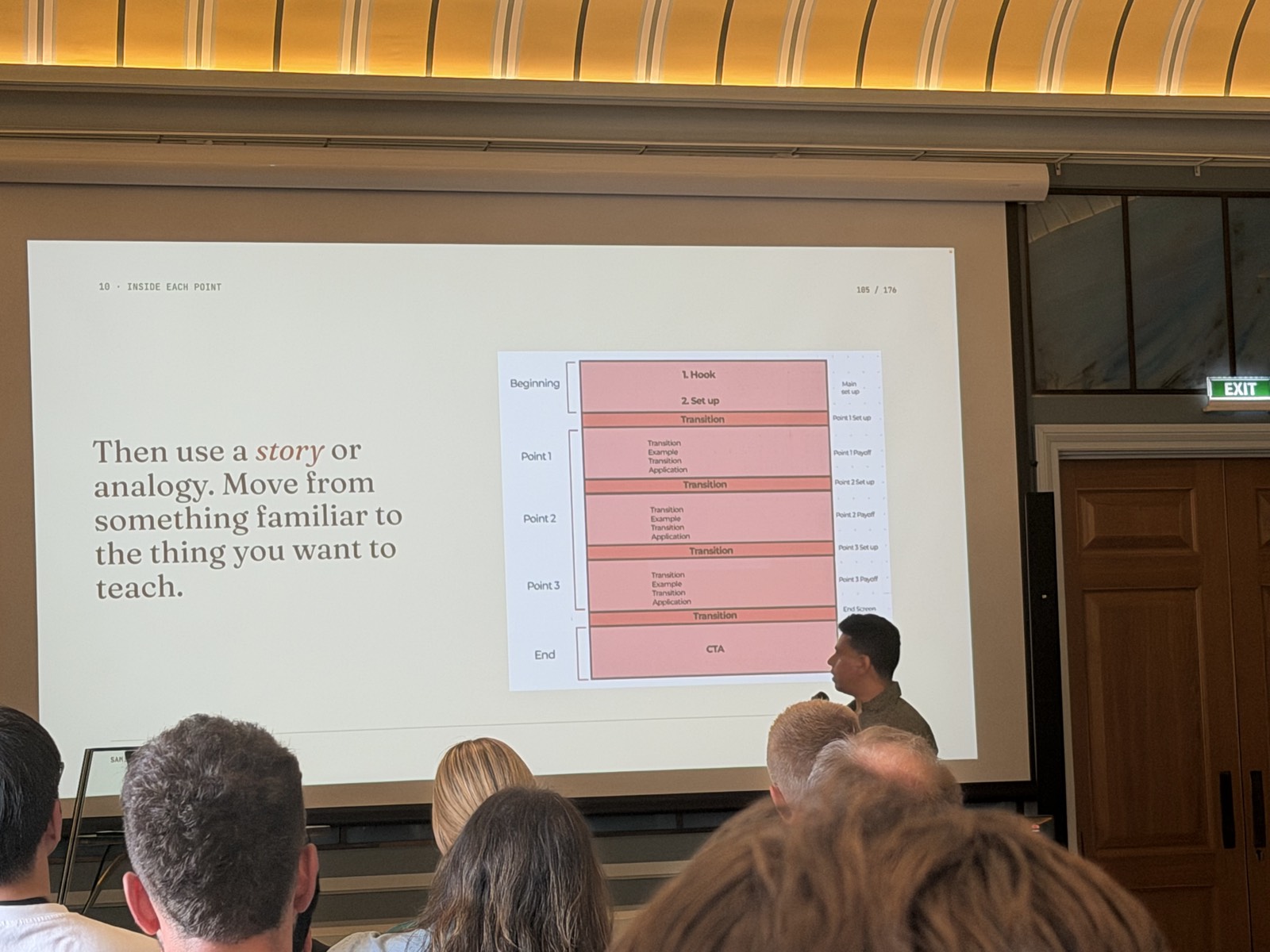
- AI organises, never writes: ramble first, let AI structure it into Hook / Setup / Points / CTA - scripts written by AI sound like nobody.
Slides (1)
Extra profit from your existing content
Lauren Tickner and Dave Ebbelaar
A live coaching hot-seat: Lauren working through Dave's creator-to-client funnel on stage. The mid-funnel machine: a monthly live "training" (never say webinar) with one evergreen opt-in page and a rotating backend, a thank-you page that books sales calls before the event, and AI-mined sales transcripts for real buying language.
Key ideas
- The thank-you page is the sales page: ICP headline, short pitch video, embedded calendar. Their benchmark: 5-7% of opt-ins book a call from the thank-you page, and the live event itself converts about 5%.
- Opt-in benchmarks: 20-25% cold, 35-40% warm organic (their benchmarks).
- Mine closed-won sales-call transcripts with AI for the language that actually made buyers buy - it becomes titles, hooks and page copy.
- Never say "webinar" - call it a training; the title should name the audience's deepest current fear.
- LinkedIn's Services marketplace: list your services, post on the topic, and inbound arrives from outside your network.
- Repurposing rule: write for the prospect's awareness level, not the client's - hook, literal bullets, one golden nugget.
Still relevant next year
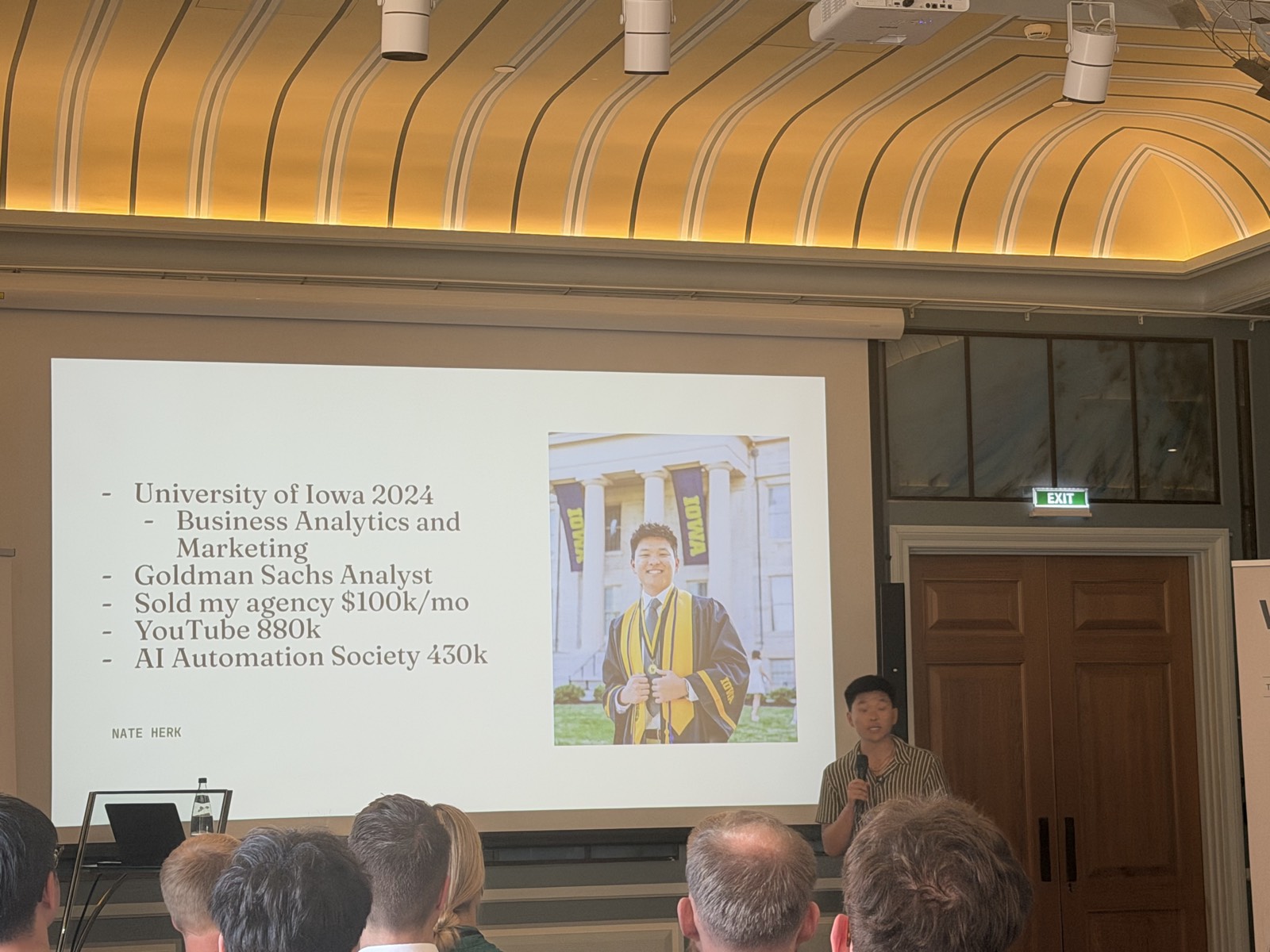
Nate Herk
How AI consultants stay relevant as the tools change: diagnose the real constraint, agree one objective KPI before building, and price on value - roughly 10% of projected annualised year-one value, so the client sees a 10x return path. He shared his pricing masterclass document with attendees.
Key ideas
- Clients buy belief, not value: diagnose the real constraint, not the request. His med spa example: she asked for lead generation; the leak was no-shows and zero follow-up.
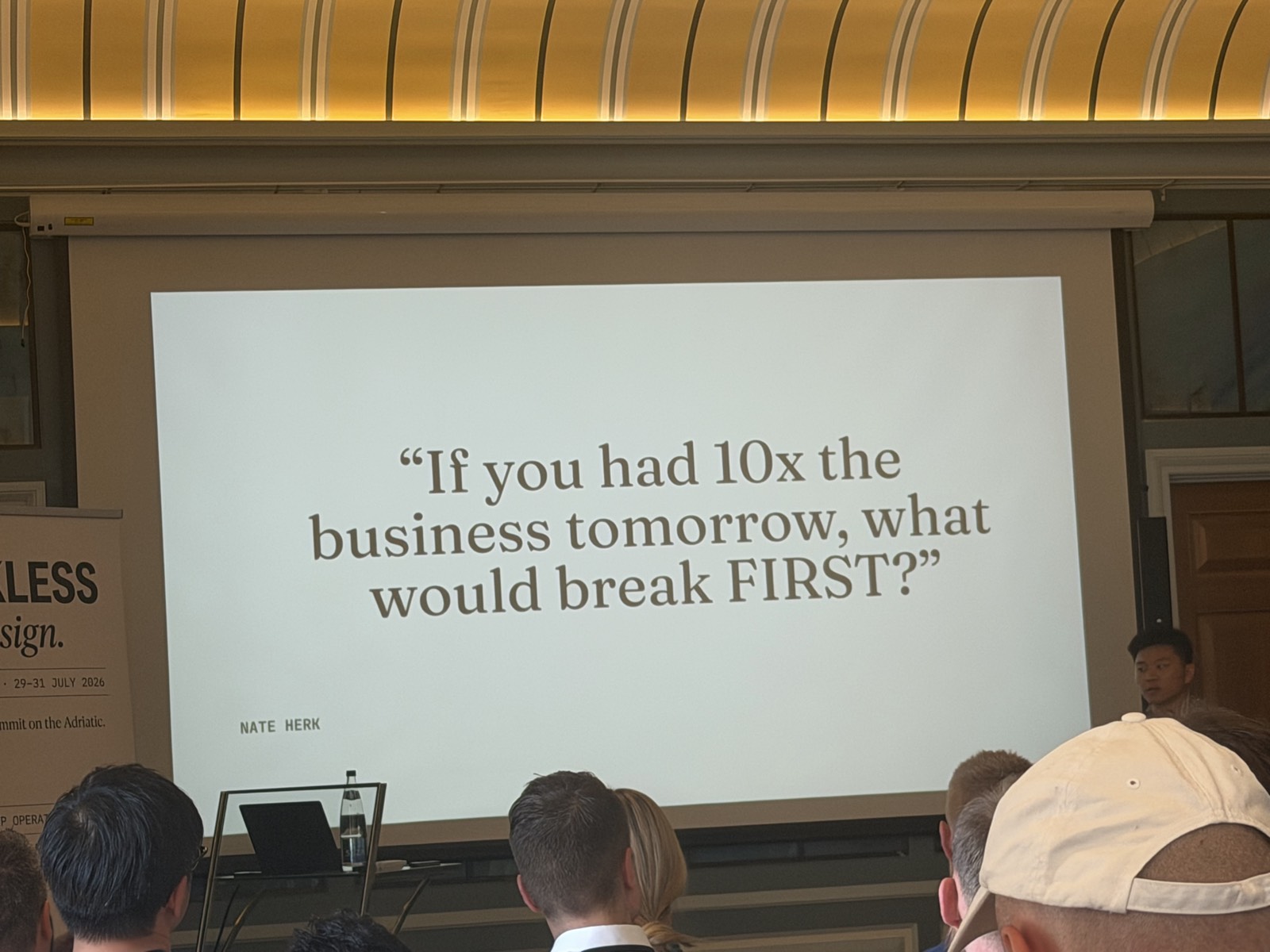
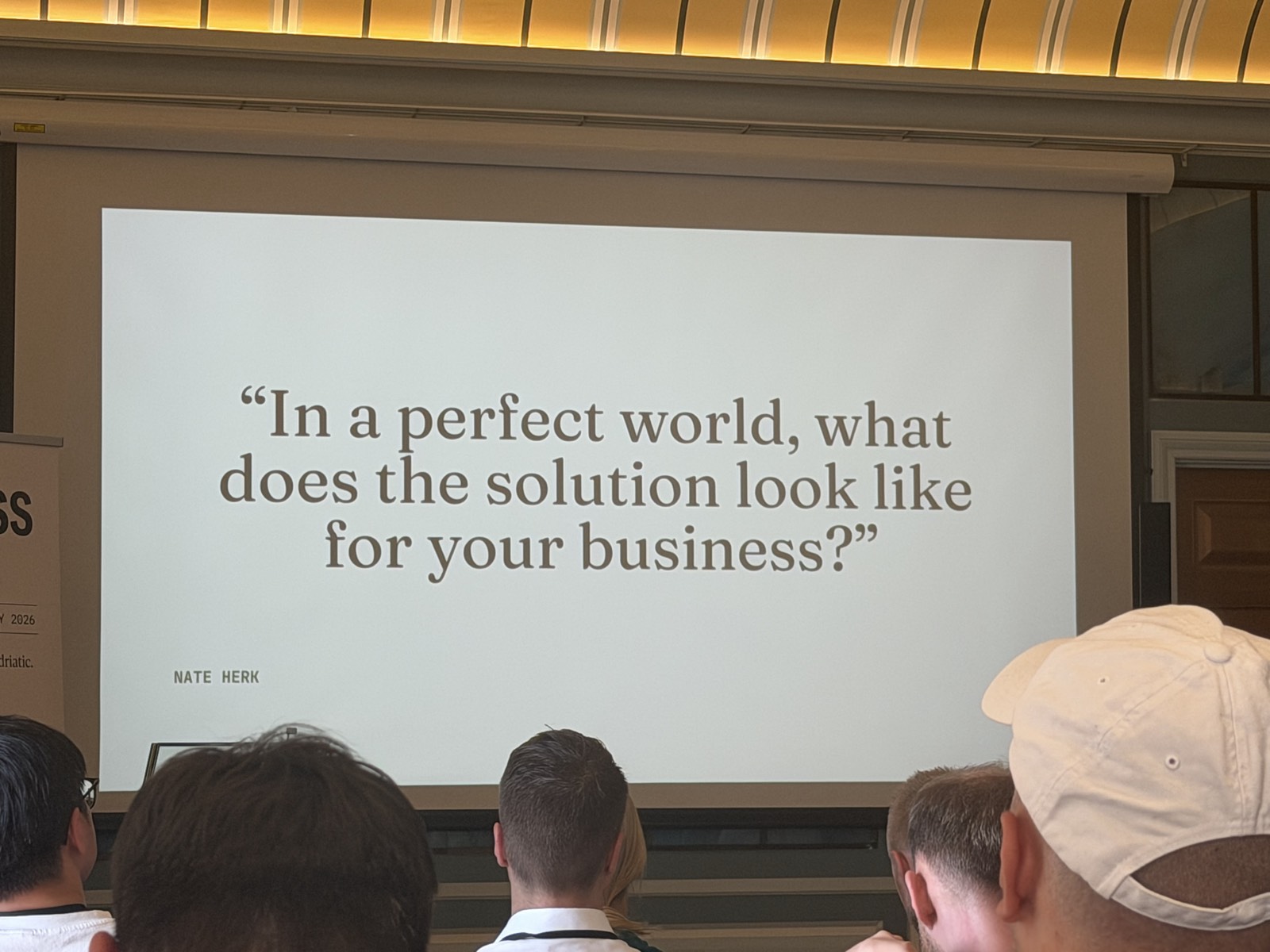
- Two discovery questions, each followed by deliberate silence: "If you had 10x the business tomorrow, what would break first?" and "How do you get 10x the water into your pipe tomorrow?"
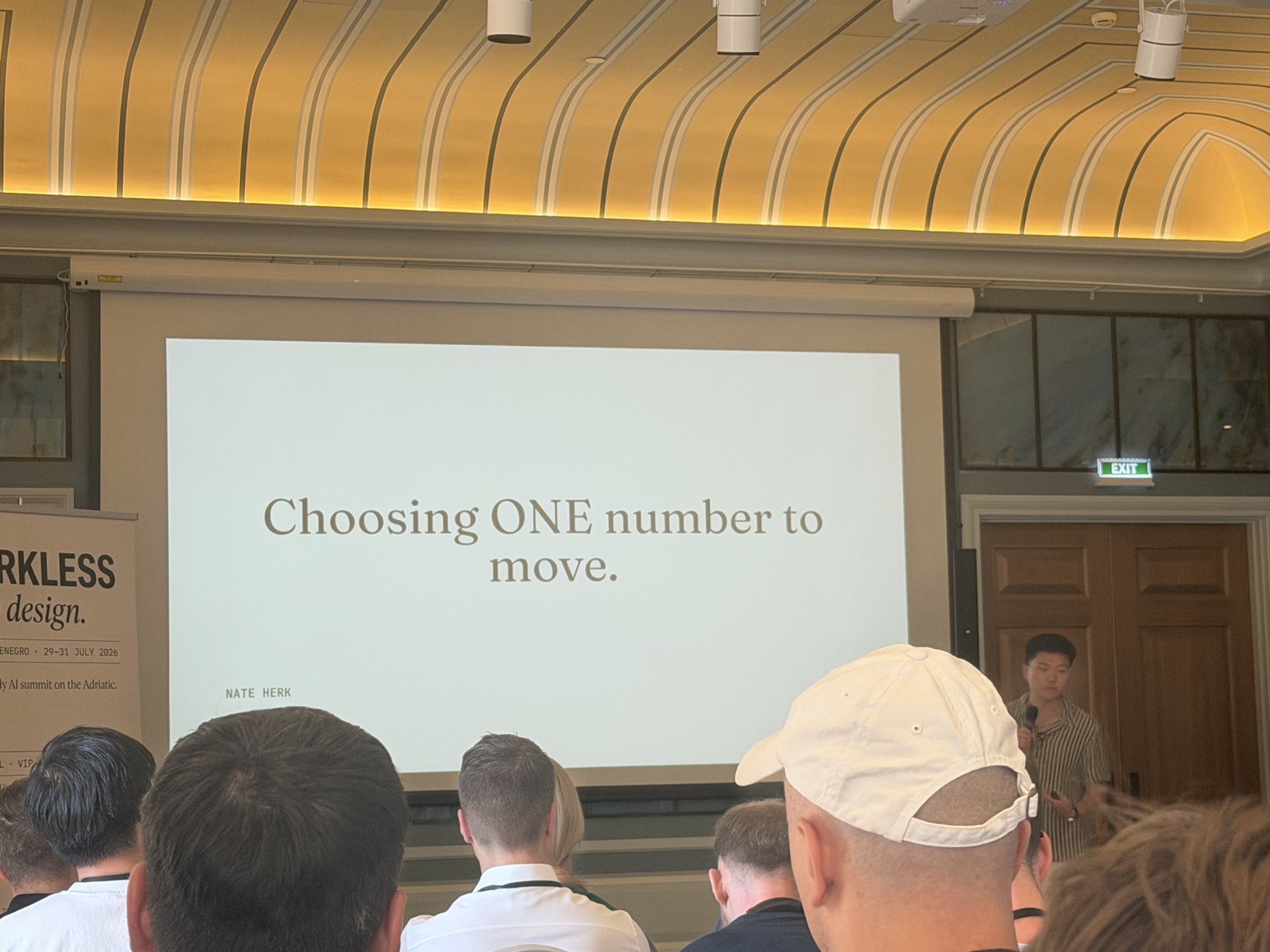
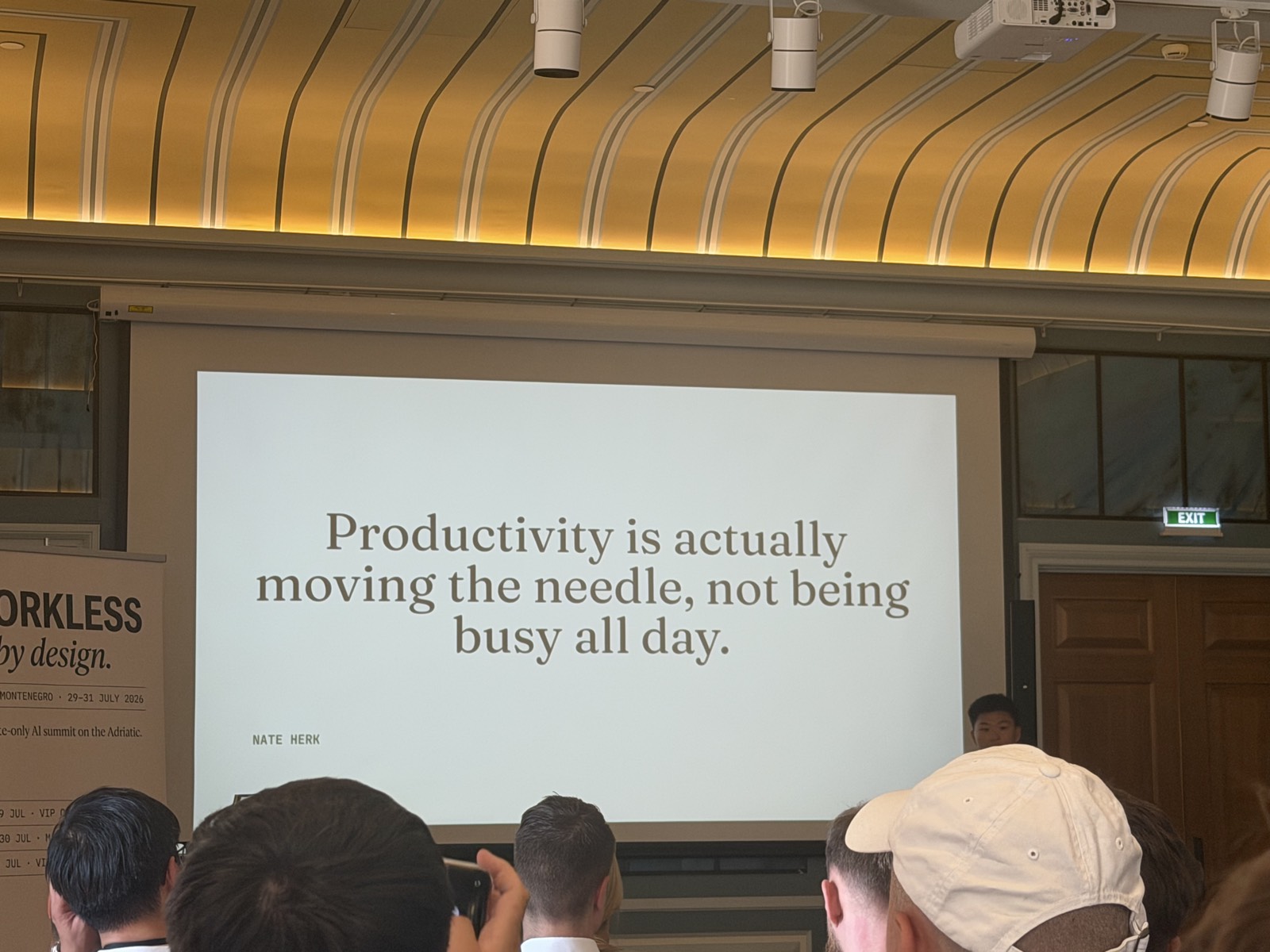
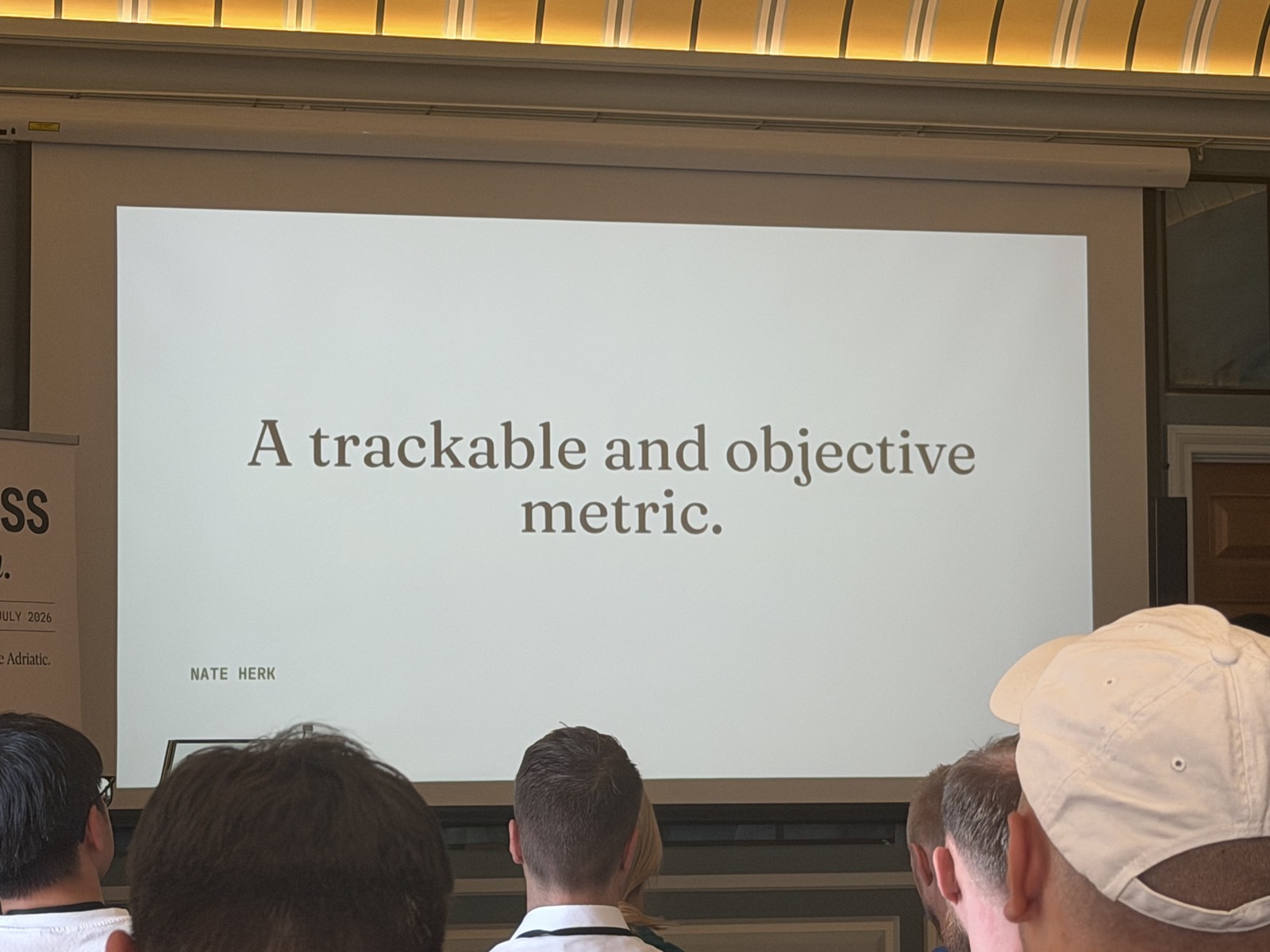
- Agree one objective KPI (baseline plus target) before building - "feeling less busy" is unprovable; "5 appointments a week to 10" is defensible.
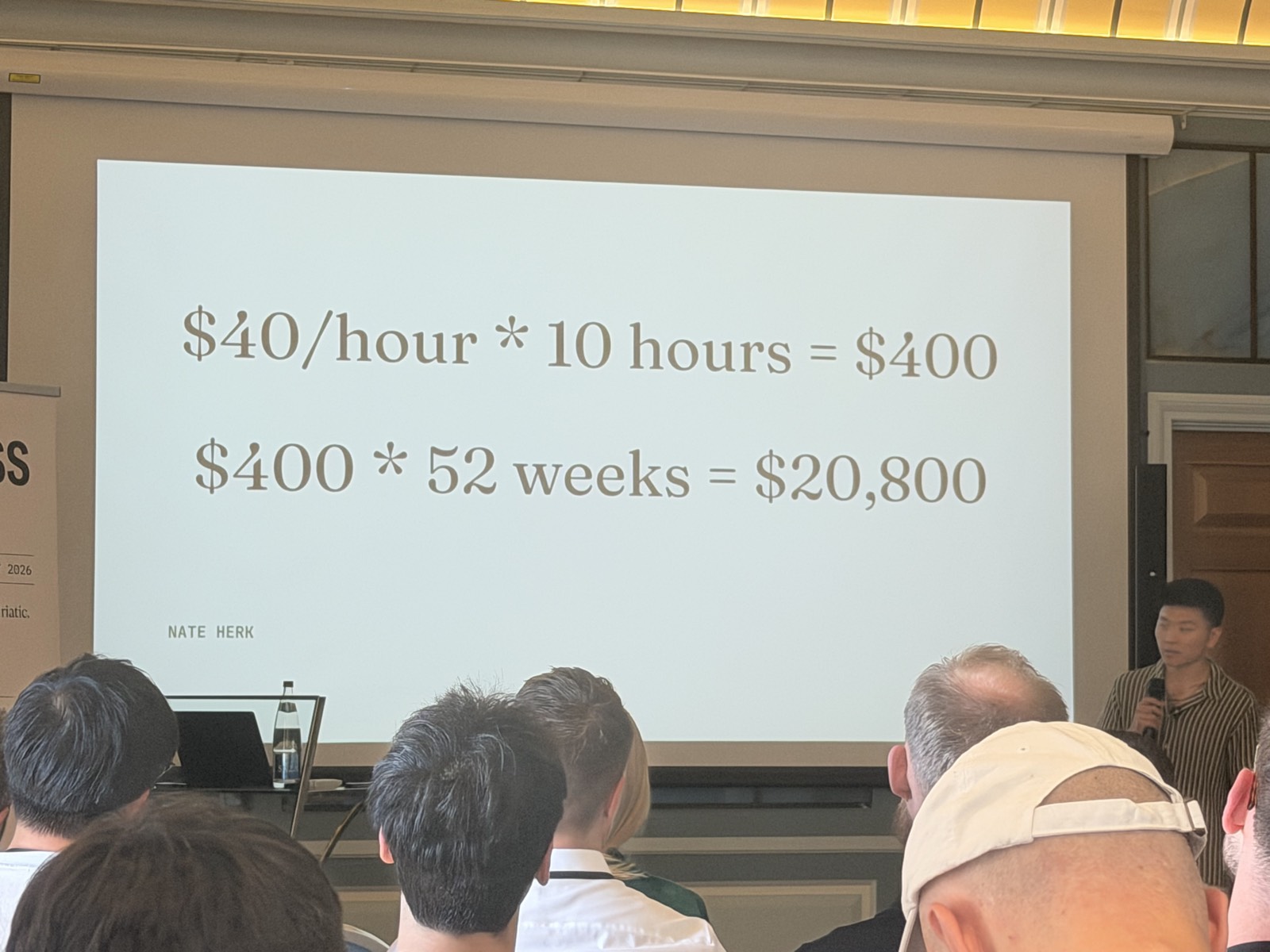
- Pricing: about 10% of annualised year-one value. The worked maths from the slide: $40/hour x 10 hours x 52 weeks = $20,800 of value, so price around $2,080. Walk the maths confidently, then silence.
- Never discount - slice scope instead: define a v1 that fits the budget at full rate and phase the rest. Discounting on first pushback teaches clients to push.
- Retainer path: return at months 1, 2 and 3 with the agreed number moved - objectivity converts a project into a retainer.
Slides (7)
Special announcement and close
Workless team
The day closed with an announcement, then moved to dinner at sea from Port Pine, Tivat.
Speaker handouts
Several speakers generously shared materials with attendees on the day: Liam Ottley's starter AI-workspace zip, Ethan Monkhouse's exit-opportunities tool, Nate Herk's pricing masterclass document, and Serdar and Emil's skills pack. If you missed one, the speakers shared them via the QR codes on their closing slides.